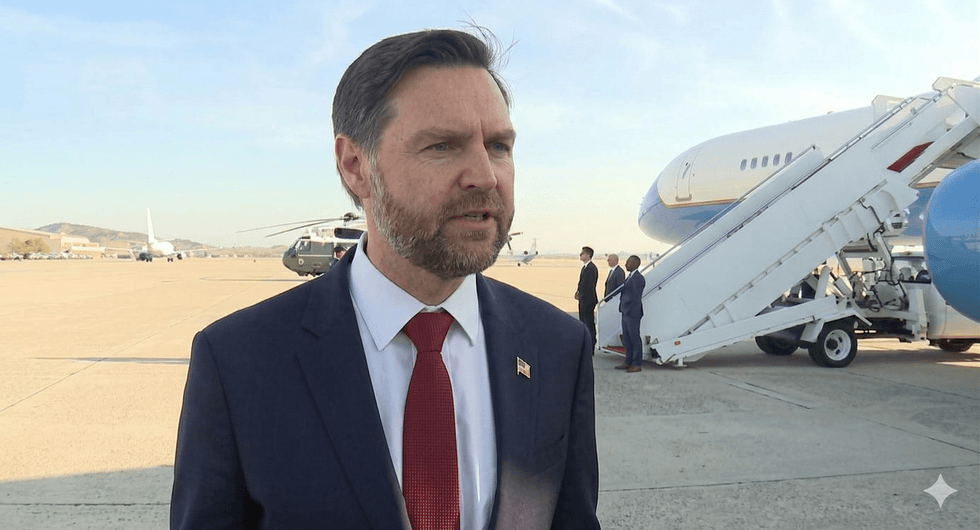
U.S. Vice President JD Vance said Friday he hopes for a “positive” outcome as he departed Washington for talks with Iran, as Pakistan prepares to host high-stakes negotiations shadowed by renewed regional tensions.
“We’re going to try to have a positive negotiation,” Vance told reporters before takeoff from Joint Base Andrews. “If the Iranians are willing to negotiate in good faith, we’re certainly willing to extend the open hand.”
He added that if Iran attempts to “play” the United States, the negotiating team “is not that receptive.”
Pakistan is set to host U.S. and Iranian delegations in its capital, Islamabad, although Tehran’s participation remained uncertain after Israeli strikes on Lebanon threatened a fragile truce.
Talks clouded by regional tensions
Iran signaled its participation could depend on a halt in Israeli military operations in Lebanon, which have intensified despite a two-week ceasefire agreed with Washington.
“The holding of talks to end the war is dependent on the U.S. adhering to its ceasefire commitments on all fronts, especially in Lebanon,” Iranian foreign ministry spokesman Esmaeil Baqaei said.
He added that details of Iran’s delegation would be announced if travel plans are finalized.
Iran’s Revolutionary Guards said they had not launched attacks during the ceasefire period, according to state media, signaling continued adherence to the agreement.
However, Israeli strikes earlier this week killed hundreds in Lebanon, raising concerns about the stability of the truce less than 48 hours after it took effect.
Attacks continued overnight, with air raid sirens sounding in Tel Aviv and other areas, while Hezbollah said it carried out drone and rocket strikes on Israeli forces and northern Israeli towns.
Parallel diplomacy efforts emerge
The United States is also preparing to host separate talks between Israel and Lebanon in Washington next week, a State Department official said.
“We can confirm that the Department will host a meeting next week to discuss ongoing ceasefire negotiations with Israel and Lebanon,” the official said.
Neither Israel nor Lebanon has publicly confirmed the talks.
The announcement followed a directive by Israeli Prime Minister Benjamin Netanyahu instructing ministers to seek direct dialogue with Lebanon focused on disarming Hezbollah.
A Lebanese government official said Beirut would require a truce before entering negotiations with Israel.
Pakistan has maintained that Lebanon is included in the ceasefire framework, a position disputed by Israel.
Mediation efforts face strain
Preparations in Islamabad continued amid heightened security, with roads closed and a luxury hotel designated for delegations cleared of regular guests.
The talks are expected to address sensitive issues, including Iran’s nuclear enrichment program and the free flow of trade through the Strait of Hormuz, a critical global energy route.
Tensions also surfaced over remarks by Pakistan’s Defense Minister Khawaja Asif, who criticized Israel’s actions in Lebanon in a social media post later deleted.
Israel’s prime minister’s office called the comments “outrageous,” saying they were unacceptable from a country presenting itself as a neutral mediator.
Pakistan does not formally recognize Israel, a factor that could complicate its role in facilitating negotiations.
German Chancellor Friedrich Merz warned that escalating violence in Lebanon could jeopardize the broader peace process.
Netanyahu, who has said Lebanon is not covered by the ceasefire, reiterated Israel’s stance.
“Anyone who acts against Israeli civilians, we will strike them,” he said. “We will continue to hit Hezbollah wherever necessary.”
U.S. President Donald Trump said Israel was “scaling back” its strikes in Lebanon and that Netanyahu had assured him operations would become more “low-key.”
Strait of Hormuz emerges as key issue
A central issue in the talks is expected to be the Strait of Hormuz, through which about a fifth of the world’s oil supply passes.
Trump accused Iran of failing to uphold commitments related to ensuring the free flow of oil through the waterway.
“Iran is doing a very poor job… of allowing Oil to go through the Strait of Hormuz,” he said on social media. “That is not the agreement we have!”
MarineTraffic data showed a Gabon-flagged oil tanker passed through the strait on Thursday, marking the first non-Iranian vessel to do so since the ceasefire was announced.
Uncertainty over Iran’s participation and continued violence in Lebanon have cast doubt over whether the talks in Pakistan will proceed as planned.
Leave a Reply