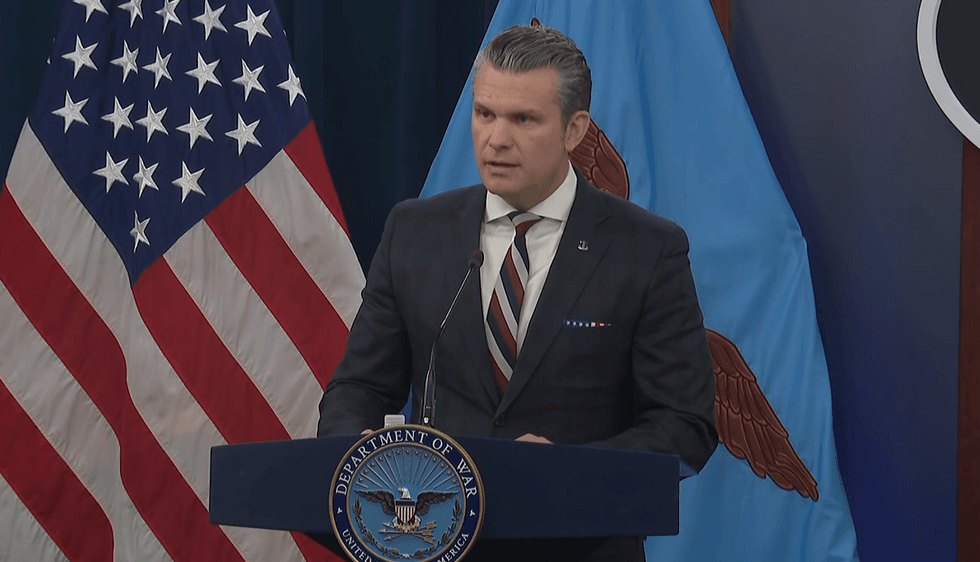
US Defense Secretary Pete Hegseth said on Wednesday that the United States was winning in the war against Iran and that the US military could fight as long as needed.
“Our air defenses and those of our allies have plenty of runway. We can sustain this fight easily for as long as we need to,” Hegseth said.
He said that the U.S. and Israel will have complete control of Iran’s skies in under a week.
“We are just getting started. We are accelerating, not decelerating. Iran’s capabilities are evaporating by the hour, while American strength grows fiercer, smarter and utterly dominant,” the defense secretary said.
“More bombers and more fighters are arriving just today.”
“And now, with complete control of the skies, we will be using 500 pound, thousand pound and 2,000 pound GG and laser guided precision gravity bombs, of which we have a nearly unlimited stockpile.”
Earlier today, a U.S. submarine torpedoed and sank an Iranian warship in the Indian Ocean, Hegseth said.
“An American submarine sank an Iranian warship that thought it was safe in international waters. Instead, it was sunk by a torpedo,” Hegseth tells reporters.
80 people killed
At least 80 people were killed in a U.S. submarine strike on an Iranian warship in the Indian Ocean, Sri Lanka’s deputy foreign minister told local television on Wednesday.
Sri Lankan authorities said they had rescued 32 people who were on board the ship and recovered several bodies from the sea.
Sri Lankan Foreign Minister Vijitha Herath told parliament that the ship, identified as IRIS Dena, had sunk.
Sri Lanka’s navy and defence ministry had earlier said the vessel had been attacked by a submarine off Sri Lanka’s Indian Ocean coast.
The spokesman said those rescued were under treatment at a state-run hospital in the southern port city of Galle.
Production shutdowns
The U.S.-Israel war on Iran has disrupted oil and natural gas exports from the Middle East and forced production stoppages from Qatar to Iraq.
OPEC’s second-largest producer, Iraq, has cut almost 1.5 million barrels per day due to storage limits and the lack of an export route, officials told Reuters. They said the country may have to shut 3 million bpd within days if exports do not resume. Total Iraqi production was about 4.1 million bpd in January, according to a Reuters survey, equal to around 4% of world output.
On top of that, in Iraqi Kurdistan several companies stopped output at their fields as a precaution. The region exported 200,000 bpd by pipeline to Turkey in February.
Qatar stopped operations at its LNG facilities on Monday, affecting some of the world’s largest plants and a source that supplies about 20% of global LNG. QatarEnergy also suspended parts of its downstream output on Tuesday. It declared force majeure on LNG shipments on March 4.
Saudi Arabia, the world’s top oil exporter, suspended output at its 550,000 bpd Ras Tanura refinery and has begun rerouting crude loadings from eastern ports to Yanbu on the Red Sea. The refinery was struck again on March 4, without sustaining damage, the Saudi defence ministry said.
Israel and Iraq’s Kurdistan region also curtailed parts of their oil and gas production.
There was also a fire caused by debris at the UAE’s Fujairah port, a key global oil storage and bunkering hub.
Strait of Hormuz closed
Traffic through the crucial Strait of Hormuz was largely closed after Iran attacked at least five ships, with a limited number of tankers transiting, choking off a key artery accounting for about 20% of global oil and LNG supply.
A senior Iranian Revolutionary Guards official said on March 2 that the Strait of Hormuz was closed and warned that Iran would fire on any ship attempting to pass.
Major marine insurers are cancelling war-risk coverage for vessels operating in Iranian, Gulf and adjacent waters.
Trump said the U.S. Navy could escort tankers through the Strait and directed the U.S. International Development Finance Corporation to provide political‑risk insurance and financial guarantees for Gulf shipping, though shipowners and analysts doubt this will be enough.
Leave a Reply