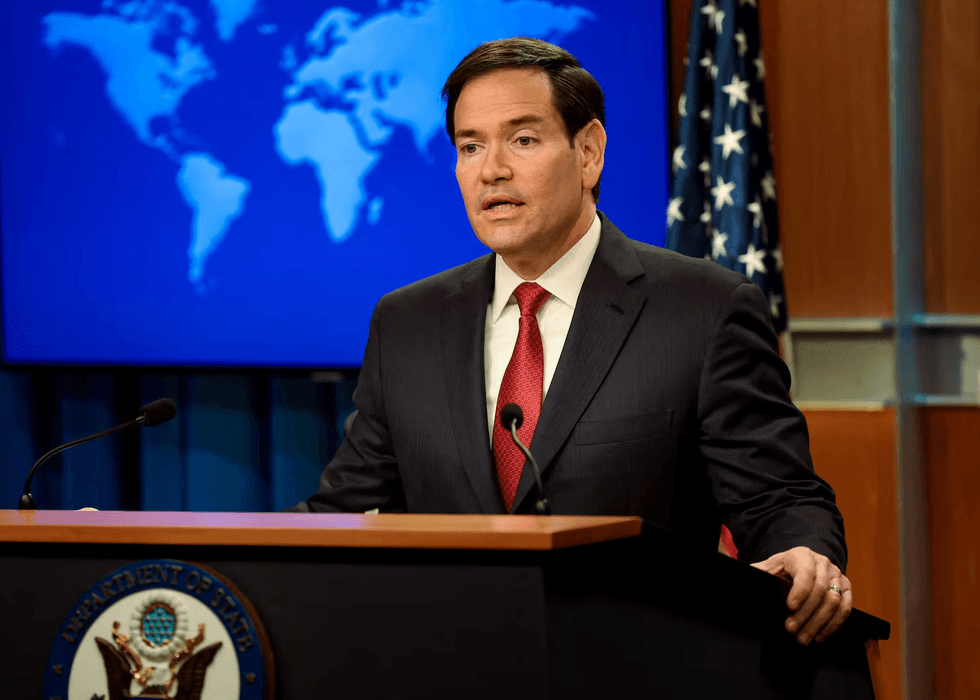
U.S. Secretary of State Marco Rubio said on Monday that a deal to end the war with Iran could still materialise, even as President Donald Trump urged caution and told negotiators not to rush.
The United States and Iran have observed a ceasefire since 8 April while mediators push for a negotiated settlement. Iran has imposed controls on Gulf shipping, and the U.S. has blockaded Iran’s ports.
Is the US still negotiating with Iran?
Yes. Rubio said on Monday that “a pretty solid thing” was on the table, focused on reopening the Strait of Hormuz, though he cautioned against reading too much into delays.
Trump posted on Sunday that the deal had been “largely negotiated,” but separately warned it was “not even fully negotiated yet.” Both sides have signalled progress while stressing that key issues remain unresolved.
What did Rubio say about the Iran deal on Monday?
Speaking to reporters in New Delhi, where he had been on an official visit, Rubio said he had expected news over the weekend but that delays should not be over-interpreted.
“We thought we might have some news last night, maybe today, I wouldn’t read too much into it,” he said. He added that Washington had “seven or eight countries in the region” endorsing its approach and was prepared to move forward.
Rubio also told The New York Times that while regional support for an agreement had grown, a nuclear deal could not be achieved “in 72 hours on the back of a napkin.”
Trump reinforced that message separately, posting: “If I make a deal with Iran, it will be a good and proper one.” Israeli Prime Minister Benjamin Netanyahu said he and Trump had agreed that any final agreement must “eliminate the nuclear threat entirely.”
Why is Trump not rushing the Iran deal?
Trump posted on Sunday that he had told his representatives “not to rush into a deal,” adding that “time is on our side.” He said the U.S. blockade would “remain in full force and effect until an agreement is reached, certified and signed.” The message came a day after Trump had suggested a deal was close, injecting fresh uncertainty into the negotiations.
Iran’s Tasnim news agency reported on Sunday that key clauses remained “unresolved at this time,” including the issue of frozen Iranian assets. Iranian officials confirmed the existence of a draft agreement but stressed that talks on Iran’s nuclear programme had been deferred for 60 days after any deal. Tehran has long rejected U.S. demands to halt uranium enrichment entirely.
What impact have the Iran deal talks had on oil prices?
Signs of diplomatic progress sent oil prices sharply lower on Monday, with Brent crude and West Texas Intermediate falling close to five percent. North Sea Brent crude slipped to $99.41 a barrel, while WTI fell to $92.49. The price moves reflected market expectations that a deal could ease restrictions on Gulf shipping and Iranian oil exports.
Iranian President Masoud Pezeshkian said Tehran was “still prepared to assure the world that we are not seeking nuclear weapons,” though it remained unclear whether that commitment would be formally included in any agreement. Iran’s Fars news agency reported that sanctions on oil, gas and petrochemicals could be temporarily lifted during the negotiation period, allowing Iran to sell its products more freely.
Which countries are involved in the Iran deal negotiations?
Leaders from Saudi Arabia, the United Arab Emirates, Qatar, Egypt, Jordan and Bahrain, alongside representatives from Turkey and Pakistan, joined a call with Trump on Saturday to discuss the deal. Pakistan, which mediated direct U.S.-Iranian talks in April, hopes to host another round “very soon,” Prime Minister Shehbaz Sharif said. Pakistan’s army chief Asim Munir, who visited Tehran on Friday and Saturday, also joined the call.
What is happening in Lebanon amid the Iran deal talks?
Israel’s military continued to strike what it described as Hezbollah targets in southern and eastern Lebanon despite an April 17 ceasefire, which both sides have broken. Iran-backed Hezbollah drew Lebanon into the war on 2 March by attacking Israel, after U.S.-Israeli strikes killed Iran’s supreme leader. Rubio on Sunday accused Hezbollah of trying to plunge Lebanon “back into chaos” and condemned the group’s call to overthrow Lebanon’s elected government.
Hezbollah leader Naim Qassem had said that “the people have the right to go down onto the streets and to bring down the government,” citing Israeli strikes and U.S. sanctions on Al-Qard Al-Hassan, a financial institution providing interest-free loans to Shia Muslims. Rubio’s remarks appeared to be a direct response to those comments.
Leave a Reply