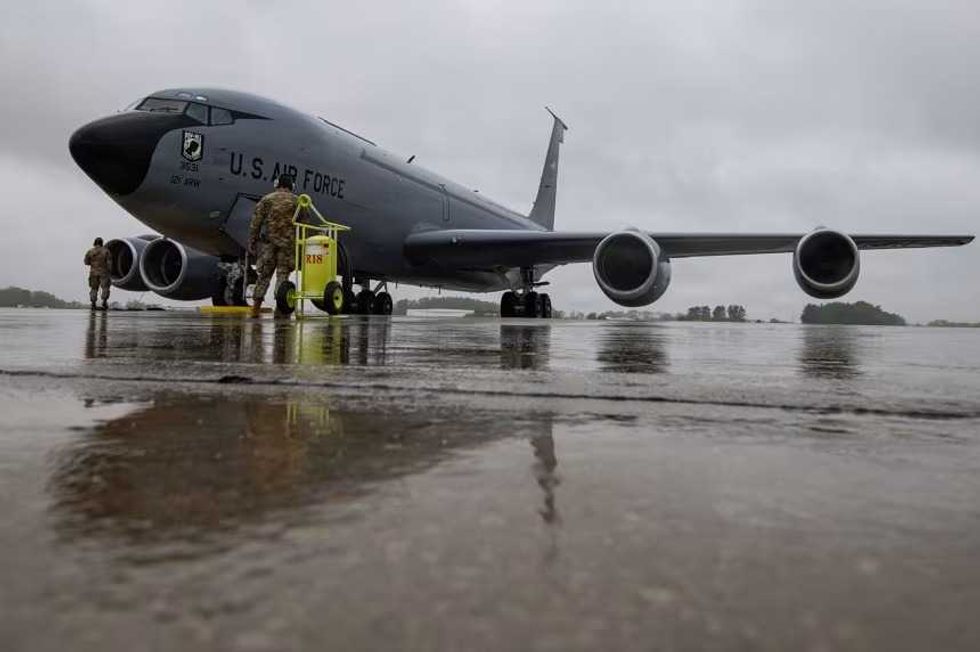
An American aerial refueling aircraft crashed in western Iraq on Friday as the conflict between the United States, Israel and Iran continued to spread across the Middle East.
The US military said a KC-135 refueling plane went down during an incident involving two aircraft, while the second plane landed safely.
“One of the aircraft went down in western Iraq, and the second landed safely. This was not due to hostile fire or friendly fire,” US Central Command said in a statement.
The incident came as the regional war, now in its 13th day, continued to trigger attacks and military activity across several countries.
The conflict began on February 28, when US and Israeli forces launched coordinated strikes on Iran. The attacks killed several senior Iranian officials, including Iran’s Supreme Leader Ayatollah Ali Khamenei and members of his family, including a grandchild. Since then, Iran and its regional allies have launched retaliatory attacks, raising fears of a wider Middle East war.
Missile attacks and regional escalation
Iran fired a new barrage of missiles toward Israel early Friday, the Israeli military said, adding that air defence systems were intercepting the incoming projectiles.
Emergency services reported that two people were injured in northern Israel during the attack.
Elsewhere in the Gulf, Saudi Arabia said it intercepted dozens of drones entering its airspace as Iran continued attacks on oil-rich Gulf states in response to the US-Israeli strikes.
The Saudi defence ministry said 12 drones were intercepted and destroyed, while authorities earlier reported at least 16 other drones had also been shot down.
Fighting spreads across Iraq and Syria
Air strikes on Thursday killed at least 11 Iran-backed fighters in Iraq, including near the Iraqi-Syrian border and in the capital Baghdad, according to security officials and members of armed factions.
Iraqi authorities condemned the strikes as “blatant attacks” on bases belonging to the Hashed al-Shaabi, a former paramilitary force that has since been integrated into Iraq’s regular military but includes brigades from Iran-aligned groups.
The conflict has also drawn in foreign forces stationed in the region.
French President Emmanuel Macron confirmed that a French soldier was killed in Iraq’s autonomous Kurdistan region, marking the first French military death linked to the wider war.
Since the conflict began, bases hosting foreign troops from the international anti-jihadist coalition have been repeatedly targeted by attacks attributed to pro-Iranian factions.
Israel expands operations in Iran and Lebanon
Israel said it had struck checkpoints in Tehran operated by the Basij paramilitary force linked to Iran’s Revolutionary Guards, part of an effort to weaken the authorities’ control in the capital.
The Israeli military later said it launched a broad new wave of strikes in Tehran, continuing its campaign against Iranian military targets.
Israel has also widened operations in neighboring Lebanon.
Air strikes hit Beirut, with footage showing dark smoke rising over the Bashoura district in the city center.
The Israeli military warned residents in southern Lebanon to move north of the Zahrani River, about 40 kilometers from the Israeli border, as it pushed deeper into the area.
It said the Iran-backed group Hezbollah had fired around 200 rockets overnight, describing it as the largest barrage since the war began.
Iran vows retaliation
Iran’s new supreme leader Mojtaba Khamenei vowed to avenge Iranian casualties in the conflict, according to a statement read on state television.
Khamenei’s father and other family members were killed in the initial strikes that triggered the war. Iranian officials have also said Khamenei himself was wounded, though details about his condition and whereabouts remain unclear.
Israeli Prime Minister Benjamin Netanyahu has publicly challenged him to “show his face.”
Trump says war moving ‘rapidly’
US President Donald Trump said the campaign against Iran was progressing quickly.
“It’s doing very well. Our military is unsurpassed,” Trump told reporters at the White House as oil shock fears grew.
The widening conflict has disrupted global energy markets, with the International Energy Agency warning that the war is causing the largest supply disruption in the history of the global oil market.
According to the agency, crude oil production has fallen by at least eight million barrels per day as Iran restricts regional energy flows.
Iran has denied laying mines in the Strait of Hormuz, a vital global shipping route, after the United States said it had struck 28 Iranian vessels allegedly preparing to deploy naval mines.
Iranian officials said some foreign ships were still being allowed to pass through the waterway, which has largely remained closed during the conflict.
Leave a Reply