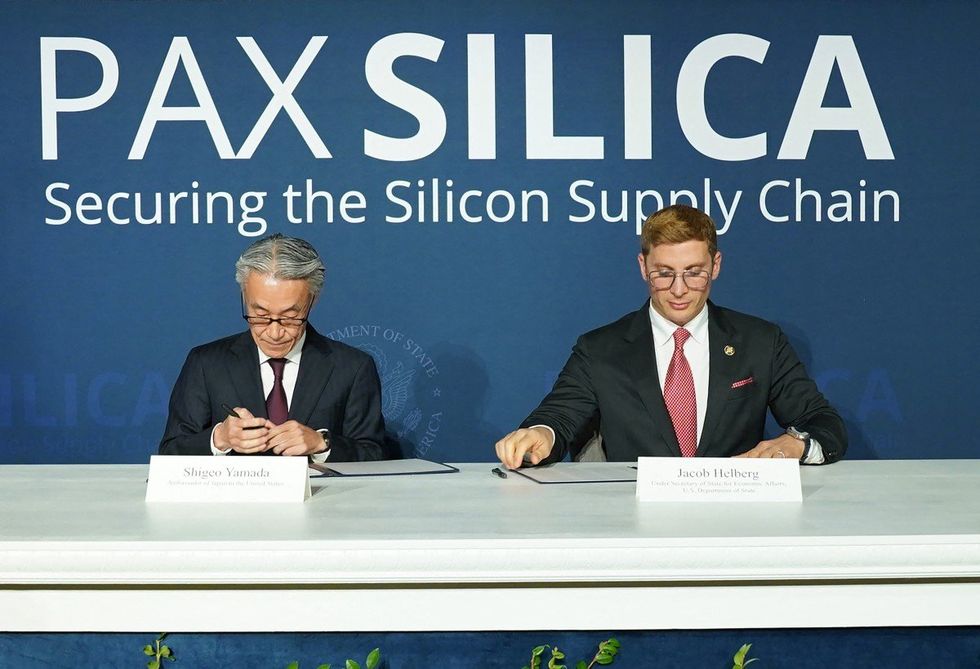
The United States on Thursday announced a new pact with allies to secure supply chains for minerals crucial to artificial intelligence, in a move aimed at countering China’s rapid rise in the sector.
Washington signed the agreement with Japan, South Korea, Singapore, and Australia, along with Israel, all of whom share concerns about China’s expanding influence over key resources.
Called the “Pax Silica,” a play on Latin terms for peace and silicon, the initiative seeks to build resilient supply chains and reduce members’ dependence on China for materials central to AI development.
“Pax Silica is a new kind of international grouping and partnership — one that aims to unite the countries that host the world’s most advanced technology companies to unleash the economic potential of the new AI age,” the State Department said in a statement.
While details were sparse, U.S. officials said participants would cooperate to ensure reliable and timely access to critical inputs.
“We believe that this gathering and grouping matters because the global system is shifting from ‘just in time’ to strategically aligned,” said Jacob Helberg, the State Department’s undersecretary for economic affairs.
“Pax Silica ultimately ensures that these countries have reliable access to the inputs and infrastructure that determine AI competitiveness,” he told reporters before the signing ceremony.
China has strengthened its control over minerals that power advanced technology, producing roughly 70 percent of key rare earth elements.
The agreement was signed in Washington even as President Donald Trump said this week he would allow the export of Nvidia’s advanced AI chips to China, reversing a ban imposed by former President Joe Biden, who cited national security concerns.
Other nations at the Washington supply-chain meetings — including the United Arab Emirates, Canada, the Netherlands, and representatives of the European Union — did not formally join the Pax Silica but participated in the talks.
Leave a Reply