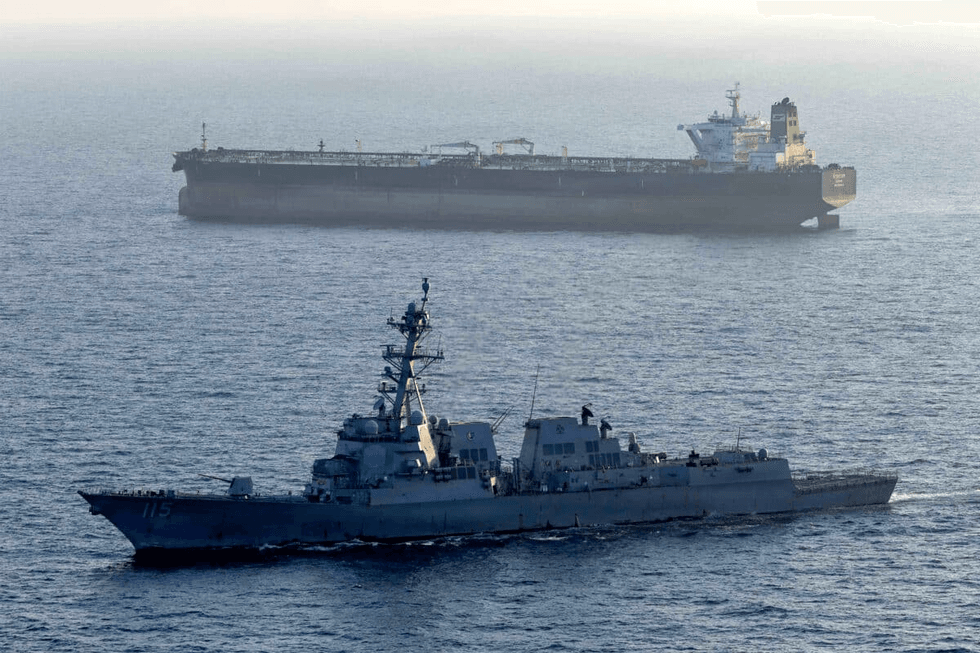
A US fighter jet on Friday disabled two Iranian-flagged tankers in the Gulf of Oman, prompting retaliatory attacks and rattling a fragile truce.
President Donald Trump said he was awaiting Tehran’s reply to his latest proposal to end the Middle East war, launched 10 weeks ago with US-Israeli strikes on Iran.
Why did the US fire on Iranian tankers?
US Central Command said an F/A-18 Super Hornet used precision munitions against two ships in the Gulf of Oman to prevent them from continuing to Iran, enforcing a blockade of Iranian ports.
Iran’s central military command accused the United States of violating the ceasefire by attacking the vessels and hampering diplomatic efforts to end the conflict.
What happened after the US tanker strikes?
An Iranian military official told local media that the country’s navy had responded to what it called “American terrorism” with strikes of its own. The official said the clashes had since ceased. The incident followed an overnight flare-up in the Strait of Hormuz, control of which an adviser to Iran’s supreme leader compared to possessing “an atomic bomb.”
US Secretary of State Marco Rubio, speaking to reporters in Rome, reiterated that it was “unacceptable” for Tehran to control the crucial oil conduit. He said Washington was expecting Iran’s response to its latest proposal later that day and expressed hope it would be “a serious offer.” Trump added from the White House: “I’m getting a letter supposedly tonight, so we’ll see how that goes.”
Where do ceasefire negotiations stand?
Washington sent Iran, via Pakistani mediators, a proposal to extend the truce in the Gulf and allow talks on a final settlement. Iran’s foreign ministry spokesman Esmaeil Baqaei said Friday the proposal was still “under review,” according to the ISNA news agency. Qatar’s prime minister, Sheikh Mohammed bin Abdulrahman Al Thani, met US Vice President JD Vance in Washington the same day to discuss the Pakistani-led brokering efforts.
Iran has repeatedly attacked sites in Qatar during the war, pointing to the emirate’s role as host of a major US air base. Saudi sources told AFP on Friday that the kingdom had refused permission for the US military to use its bases and airspace for a Hormuz operation, with one source saying Riyadh felt it “would just escalate the situation and would not work.” Trump had announced that naval operation on Sunday, only to abandon it on Tuesday in favor of returning to negotiations.
What is the oil slick near Kharg Island?
Satellite images have shown an oil slick spreading off the coast of Iran’s Kharg Island, a key oil export terminal. The spill appears to cover more than 20 square miles (52 square kilometers), according to global monitor Orbital EOS, and is located off the island’s west coast. The cause had not been immediately confirmed.
Kharg Island sits at the heart of Iran’s oil export industry and lies in the Gulf, north of the Strait of Hormuz. Following the start of the war on 28 February, Iran largely closed the strait, throwing global markets into turmoil and driving up oil prices. The US later imposed its own blockade of Iranian ports in response.
What is happening on the Lebanon front?
A parallel ceasefire in Lebanon was also under strain on Friday. Hezbollah said a salvo of missiles targeted a base south of the Israeli city of Nahariya, in response to Israeli strikes on Beirut’s southern suburbs and southern Lebanon. Hours later, the Iran-backed group announced it had launched a swarm of drones at another base in northern Israel.
Israel has continued striking Hezbollah despite the ceasefire, including its first attack on Beirut’s southern suburbs in a month on Wednesday, which it said killed a senior Hezbollah commander. The Lebanese health ministry said Israeli strikes in the south killed 10 people on Friday, including two children and three women. Lebanon’s civil defense said one of its own members was also killed.
The violence came as Lebanon and Israel were set to hold direct negotiations in Washington the following week, talks that Hezbollah vehemently opposes. The two countries have been officially at war since 1948.
Leave a Reply