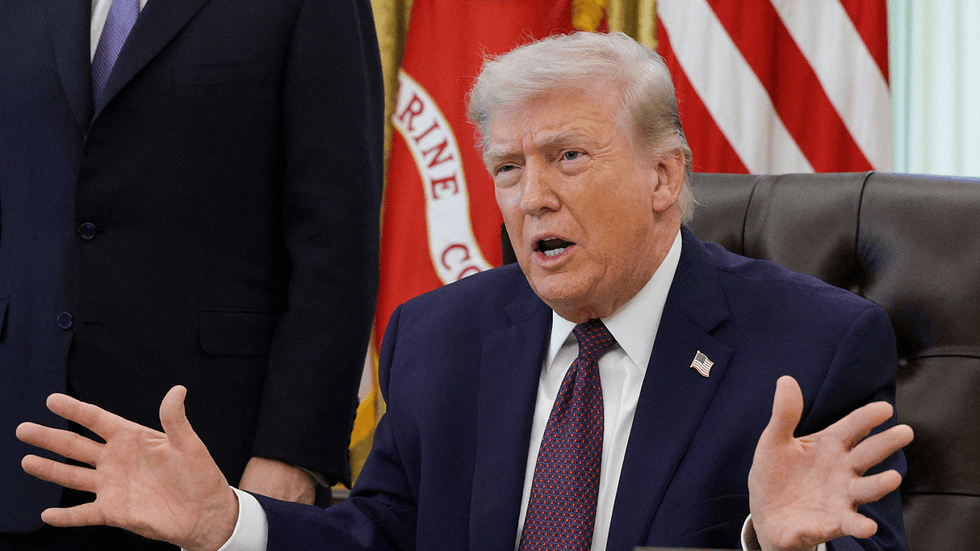
US President Donald Trump warned that the ceasefire in the Middle East war was on “massive life support” after rejecting Iran’s latest counteroffer.
Iran’s parliamentary speaker responded by saying its armed forces stood ready to respond to any aggression. The breakdown dashed hopes of a quick deal to reopen the Strait of Hormuz to commercial shipping.
What did Trump say about the Middle East ceasefire?
Trump declared the month-long Middle East ceasefire was effectively dying after he rejected Iran’s 14-point counterproposal. He said the United States would achieve “complete victory” over Iran. The ceasefire had largely halted fighting in the Gulf since it was announced on April 7.
Why did Trump reject Iran’s counterproposal?
Trump called Iran’s response “TOTALLY UNACCEPTABLE” without disclosing its full contents. Tehran’s foreign ministry confirmed the proposal called for an end to the US naval blockade of Iranian ports and a halt to the war across the region, which implicitly included stopping Israeli strikes on Hezbollah in Lebanon.
Iran also demanded the release of assets held in foreign banks, a long-standing demand that would ease the country’s economic isolation.
The Wall Street Journal, citing people familiar with the matter, reported Iran’s proposal included a possible offer to dilute some of its highly enriched uranium, with the remainder transferred to a third country.
Any end to international sanctions, however, would reduce Washington’s leverage over Tehran as it pursues a lasting halt to Iran’s nuclear enrichment. Israel’s Prime Minister Benjamin Netanyahu has insisted the conflict will not end until Iran’s nuclear facilities are destroyed.
How has Iran responded to Trump’s rejection?
Iranian parliamentary speaker Mohammad Bagher Ghalibaf, who served as chief negotiator in earlier talks with Washington, said Iran’s armed forces were ready to “teach a lesson for any aggression.”
He added on X that there was “no alternative” but to accept the terms in Iran’s proposal. “The longer they drag their feet, the more American taxpayers will pay for it,” he said.
What does the breakdown mean for oil markets and energy supply?
The collapsed negotiations rattled global energy markets already destabilized by the war and overlapping blockades around the Strait of Hormuz, a vital conduit for oil and gas shipments.
Aramco CEO Amin Nasser told investors the energy supply shock that began in the first quarter was the largest the world had ever experienced. He warned that if the strait’s reopening was delayed by several more weeks, market normalization could stretch into 2027.
Could a food crisis follow the energy shock?
The conflict has also created a global fertilizer shortage, as much of the world’s supply moves through Gulf ports. Jorge Moreira da Silva, executive director of the United Nations Office for Project Services, told AFP there were just weeks left to avert what he called a potentially “massive humanitarian crisis.” He warned the crisis could push 45 million more people into hunger and starvation.
What is the US considering doing about the Strait of Hormuz?
Iran has been restricting maritime traffic through the strait and establishing a toll-charging mechanism for crossing ships. Trump told Fox News he was considering reviving a short-lived US operation to escort oil tankers and commercial vessels through Hormuz, though he said no final decision had been made.
Saudi sources previously told AFP that Saudi Arabia had blocked the US from using its airspace and bases for that operation the first time, citing fears it would escalate the situation without resolving it.
The United States also issued sanctions against 12 individuals and companies in Iran, Hong Kong and the UAE, which it said had facilitated the sale and shipment of Iranian oil to China, in a move designed to increase economic pressure on Tehran.
The Wall Street Journal also reported Monday that the United Arab Emirates had carried out attacks on a refinery on Iran’s Lavan Island in early April, revealing previously undisclosed Emirati participation in the war. AFP has not been able to independently verify those attacks, which the newspaper said took place around the time Trump announced the ceasefire.
Leave a Reply