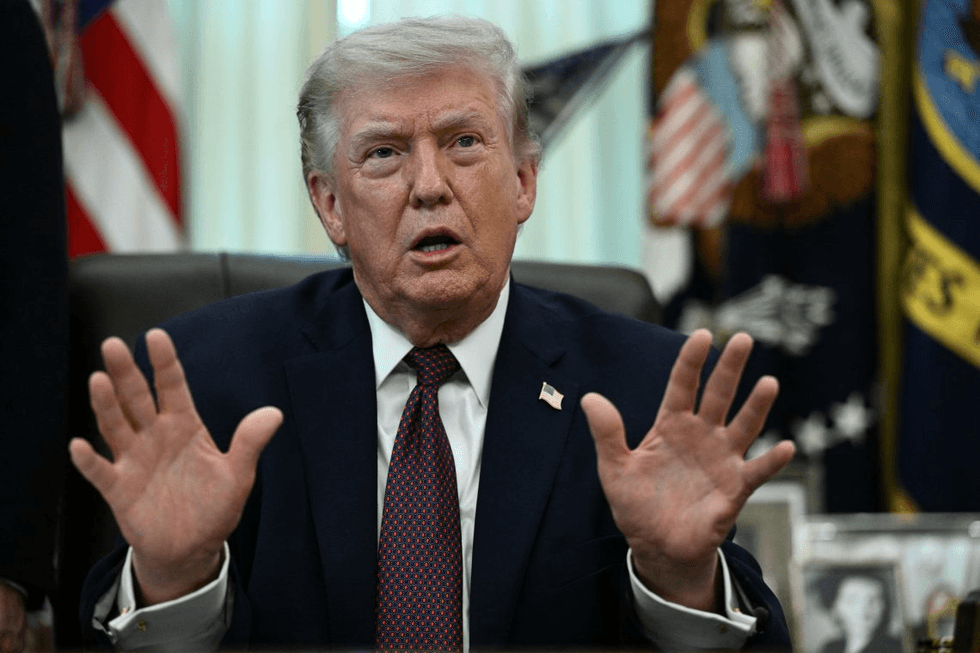
US President Donald Trump late Wednesday said US military deployed near Iran would remains stationed in the area until a “real agreement” is reached, as it enters a fragile two-week ceasefire with Tehran.
“All U.S. Ships, Aircraft, and Military Personnel, with additional Ammunition, Weaponry, and anything else that is appropriate and necessary for the lethal prosecution and destruction of an already substantially degraded Enemy, will remain in place in, and around, Iran, until such time as the REAL AGREEMENT reached is fully complied with,” Trump wrote on his Truth Social platform.
Meanwhile, the truce entered its second day on Thursday, with Tehran threatening to resume hostilities as Israel launched a major bombardment of Lebanon.
Tensions rise despite truce
Both Washington and Tehran claimed victory after agreeing to the ceasefire, designed to halt a conflict that has already killed thousands across the Middle East and shaken global markets. However, cracks in the agreement emerged quickly. Israel conducted its heaviest strikes on central Beirut since Hezbollah joined the war in early March.
At least 182 people were killed and nearly 900 wounded, according to the Lebanese Health Ministry. Israel maintained that its operations against Hezbollah were not part of the US-Iran truce, a position supported by US Vice President JD Vance, who is scheduled to lead talks with Tehran in Pakistan.
“If Iran wants to let this negotiation fall apart over Lebanon, which has nothing to do with them, and which the United States never once said was part of the ceasefire, that’s ultimately their choice,” Vance said.
But Iran’s parliament speaker Mohammad Bagher Ghalibaf appeared to threaten the ceasefire, claiming on X that the “workable basis on which to negotiate” had already been violated, making further talks “unreasonable.”
‘Violations’
Ghalibaf cited three alleged US breaches of the truce: ongoing attacks in Lebanon, a drone entering Iranian airspace, and denial of Iran’s right to uranium enrichment. Adding to the fragility, a senior US official noted that Iran’s 10-point plan did not match the conditions the White House had agreed to for the ceasefire.
In Lebanon, the UN rights chief Volker Turk described the scale of civilian casualties as “horrific.” Airstrikes across Beirut triggered panic and chaos. “People started running left and right, and smoke was billowing,” said Ali Younes, near one of the targeted areas.
More than 1,700 people have died in Lebanon since Israel launched its air and ground operations last month. Iran’s Revolutionary Guards warned they would “fulfil our duty and deliver a response” if Israel continued strikes, while Hezbollah insisted it had a “right” to retaliate. Israeli Prime Minister Benjamin Netanyahu said the country remains prepared to confront Iran, with military objectives including disarming Hezbollah. Pentagon chief Pete Hegseth also reaffirmed that US forces are ready if the conflict escalates again.
High-stakes talks ahead
The escalating rhetoric comes ahead of high-stakes talks in Pakistan expected this weekend, after Iran temporarily agreed to reopen the Strait of Hormuz under US pressure. Despite the ceasefire, reports indicated the waterway closed again later Wednesday, which the White House called “completely unacceptable.”
Iran announced alternative routes for ships citing the risk of sea mines. Pakistani Prime Minister Shehbaz Sharif, who helped mediate the truce, urged all parties to “exercise restraint and respect the ceasefire for two weeks” to allow diplomacy to succeed.
Further casting doubt on the truce’s durability, Iranian state media reported fresh missile and drone strikes against US-allied Gulf states, including Kuwait, UAE, Saudi Arabia, and Bahrain, in retaliation for attacks on Iranian oil facilities.
In Tehran, streets were quieter than usual, with many shops closed after a tense night fearing a massive US strike. “Everyone is at ease now,” said Sakineh Mohammadi, a 50-year-old housewife. “We are more relaxed and proud of our country.”
Global reactions
European leaders, Canada, and the UK called for a “swift and lasting end to the war,” while Pope Leo hailed a moment of “real hope.” Yet Tehran’s demands over uranium enrichment, sanctions, and control of the Strait of Hormuz remain at odds with US objectives.
The US and Israel justified their attacks as measures to degrade Iran’s military capability. After weeks of market turmoil, the ceasefire announcement sent oil prices down 15 percent and European natural gas down 20 percent.
Trump, frustrated with NATO’s role during the conflict, warned the alliance “won’t be there” for the US. As he met with NATO’s chief in Washington, the White House said discussions may include the possibility of leaving the alliance.
Leave a Reply