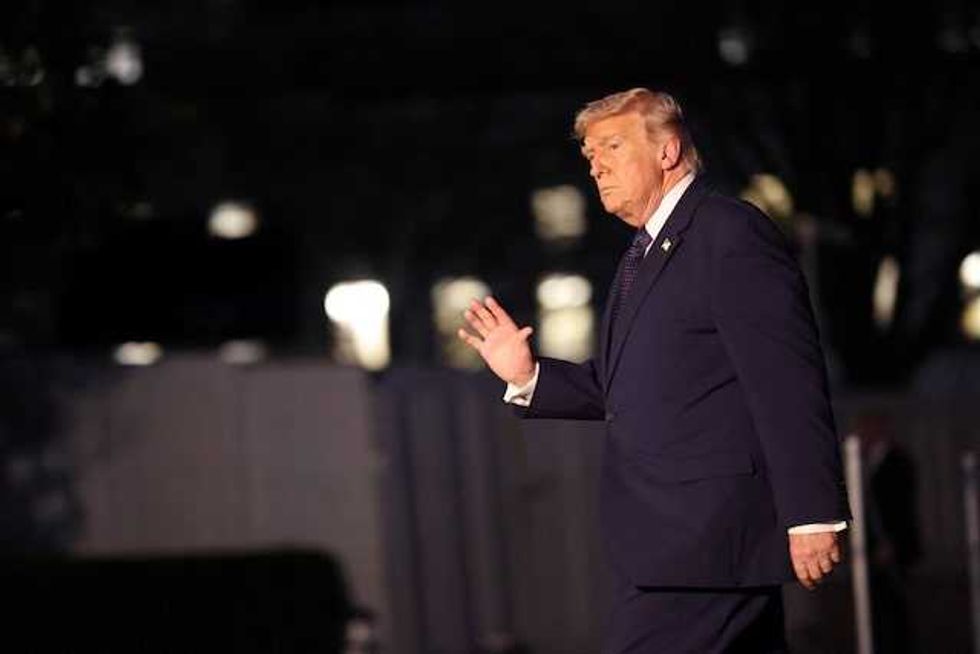
U.S. President Donald Trump said it is possible he would talk with Iran, but only depending on the terms, according to an interview broadcast by Fox News.
The cable network said Tuesday that Trump made the remarks during an interview Monday evening when asked about potential negotiations with Tehran.
Trump told Fox he had heard that Tehran “wanted to talk badly,” according to the network.
The Republican president also reiterated his dissatisfaction with Iran’s new Supreme Leader, Mojtaba Khamenei. “I don’t believe he can live in peace,” Trump said.
In the same interview, Trump echoed comments he made earlier at a press conference, saying the results of the U.S. military operation in Iran were “way beyond expectation.”
He added that he was surprised Iran was striking Gulf countries with missiles and drones, Fox reported.
Separately, oil prices fell sharply Tuesday after surging to their highest level in more than three years during the previous session.
Brent crude futures dropped $6.64, or 6.7%, to $92.32 a barrel by 1202 GMT. U.S. West Texas Intermediate crude fell $5.44, or 5.7%, to $89.33 a barrel. Both benchmarks had declined as much as 11% earlier in the day.
The decline followed a spike above $119 a barrel on Monday, the highest since mid-2022, amid concerns over potential supply disruptions linked to the conflict involving Iran.
Trading volumes also declined. Brent volumes fell to about 284,000 contracts, the lowest since Feb. 27, shortly before the start of the U.S.-Israeli war on Iran. West Texas Intermediate volumes dropped to 255,000 contracts, the lowest since Feb. 20.
Prices retreated after Russian President Vladimir Putin held a phone call with Trump and shared proposals aimed at a quick settlement to the war, according to a Kremlin aide.
Trump said Monday in an interview with CBS News that he believed the war against Iran was “very complete” and that Washington was “very far ahead” of his initial four- to five-week timeframe.
Market analysts said Trump’s comments suggesting a shorter conflict had eased some concerns.
“Clearly Trump’s comments about a short-lived war have calmed markets,” said Suvro Sarkar, energy sector team lead at DBS Bank. He added that the market may have overreacted both to the upside and the downside.
He noted that Murban and Dubai crude grades remained above $100 per barrel.
In response to Trump’s remarks, Iran’s Islamic Revolutionary Guards Corps said it would “determine the end of the war” and would not allow “one litre of oil” to be exported from the region if U.S. and Israeli attacks continued, according to Iranian state media.
Meanwhile, Trump is considering easing oil sanctions on Russia and releasing emergency crude stockpiles as part of options aimed at curbing rising prices, according to multiple sources.
Priyanka Sachdeva, an analyst at Phillip Nova, said discussions about easing sanctions on Russian oil, along with comments indicating possible de-escalation, suggested that supply could continue reaching global markets.
She said that once traders sensed supply routes might be maintained, the “panic premium” that had pushed prices above $100 a barrel began to fade.
Saudi Aramco, the world’s largest oil exporter, warned Tuesday of “catastrophic consequences” for global markets if the war disrupts shipping in the Strait of Hormuz.
JPMorgan said in a note that policy measures might have limited impact unless safe passage through the Strait of Hormuz is assured, citing potential losses of up to 12 million barrels per day over the next two weeks.
Goldman Sachs said it was maintaining its oil price forecast at $66 per barrel for Brent in the fourth quarter and $62 for West Texas Intermediate, citing the fluid situation.
Energy ministers from the Group of Seven industrialized nations were scheduled to discuss rising energy prices in a call Tuesday. European Union leaders were also expected to address the issue later in the day, officials said.
Leave a Reply