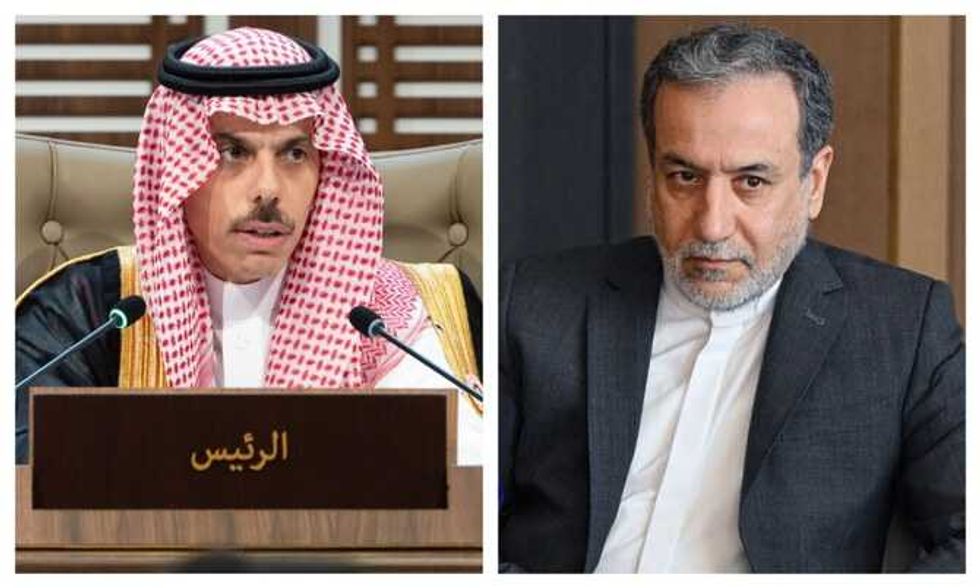
Saudi Foreign Minister Prince Faisal bin Farhan spoke by phone with his Iranian counterpart Abbas Araghchi, marking the first official contact between the two countries since Tehran launched strikes against Gulf neighbors in retaliation for Israeli-American attacks, the Saudi Foreign Ministry said Thursday.
The ministry said the call focused on “reviewing developments in the situation and ways to slow the pace of tensions so as to help restore security and stability in the region.”
The statement was issued a day after a two-week ceasefire between the United States and Iran was announced by Pakistani Prime Minister Shehbaz Sharif.
Ceasefire faces strain over Lebanon
Calls were mounting Thursday for the U.S.-Iran truce to be extended to Israel’s war with Hezbollah in Lebanon, after a wave of Israeli strikes killed more than 200 people.
Lebanon’s health ministry said at least 203 people were killed and 1,000 wounded in Israeli strikes on Wednesday.
U.S. President Donald Trump claimed victory in the Middle East war after agreeing to the two-week truce aimed at ending a conflict that has killed thousands and shaken the global economy.
But the future of negotiations appeared uncertain after Iran denounced Israel’s ongoing raids on Lebanon.
Tehran’s ambassador to Pakistan, Reza Amiri Moghadam, deleted a social media post that had said an Iranian delegation would travel to Islamabad for talks. An official at the Iranian embassy in Islamabad told AFP the post was removed “because of some issues” and declined to confirm whether the delegation would still arrive.
There have been conflicting diplomatic signals over whether Lebanon was included in the U.S.-Iran truce. Washington said it was not, and Israel indicated it would continue operations.
“We are continuing to strike Hezbollah with force, precision, and determination,” Israeli Prime Minister Benjamin Netanyahu said in a social media post. He added that Israel would strike anyone acting against its civilians.
Hezbollah said it fired rockets toward Israel in response to what it described as a violation of the truce.
U.S. Vice President JD Vance said Lebanon was not part of the ceasefire and warned that if Iran chose to let negotiations collapse over Lebanon, “that’s ultimately their choice.”
Iran’s parliament speaker Mohammad Bagher Ghalibaf said on X that the “workable basis on which to negotiate” had been violated, making further talks “unreasonable.” He cited three alleged U.S. violations: continued attacks in Lebanon, a drone entering Iranian airspace and Washington’s opposition to Iran’s uranium enrichment rights.
International calls for restraint
European Union foreign policy chief Kaja Kallas said Israeli actions were putting the ceasefire under “severe strain” and called for the truce to extend to Lebanon.
France’s foreign minister Jean-Noel Barrot condemned the strikes as “unacceptable,” while Britain’s Home Secretary Yvette Cooper called for Lebanon to be included in the ceasefire.
The Lebanese prime minister’s office declared Thursday a national day of mourning for victims of the Israeli attacks.
U.N. rights chief Volker Turk described the scale of killing in Lebanon as “horrific,” after strikes across Beirut triggered panic.
“People started running left and right, and smoke was billowing,” said Ali Younes, who was waiting for his wife near Corniche Al-Mazraa.
High-stakes talks ahead
The escalation comes ahead of talks expected in Pakistan on Friday or Saturday.
A key issue remains the Strait of Hormuz, a strategic waterway through which about a fifth of the world’s oil and large volumes of natural gas and fertilizer transit in peacetime.
Iran announced alternative shipping routes Thursday, citing the risk of sea mines. It was unclear whether vessels were being allowed to pass through the strait, following reports it had been shut. The White House called any closure “completely unacceptable.”
Pakistani Prime Minister Shehbaz Sharif, whose country mediated the ceasefire, urged all sides in a social media post to “exercise restraint and respect the ceasefire for two weeks” to allow diplomacy to proceed.
Iranian state media reported fresh missile and drone attacks against U.S.-allied Gulf states in retaliation for airstrikes on Iranian oil facilities. Kuwait, the United Arab Emirates, Saudi Arabia and Bahrain reported strikes after the ceasefire took effect.
In Tehran, streets were quieter than usual Wednesday, with many shops closed after what residents described as an anxious night.
“Everyone is at ease now,” said Sakineh Mohammadi, a 50-year-old housewife. “We are more relaxed.”
Leave a Reply