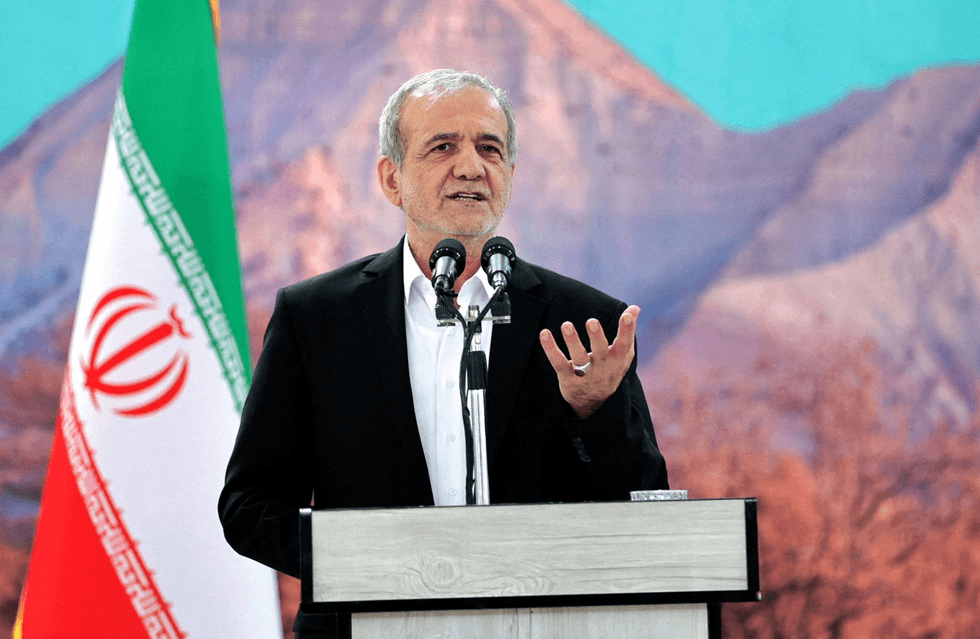
Iranian President Masoud Pezeshkian said no power can force the Iranian nation into submission, criticizing what he described as double standards in the international system and condemning attacks on sovereign states, state news agency IRNA reported.
Pezeshkian made the remarks on Wednesday during a visit to several departments of the Tehran Province Emergency Organization, where he reviewed operational readiness, service delivery and specialized capacities.
He praised the organization’s performance, particularly during what he described as a 40-day US-Israeli war, calling emergency services a key pillar of national crisis management and essential to maintaining vital public services under pressure.
Emphasizing the importance of cohesion across society and institutions, he said sustained unity would enhance national strength. “In such circumstances, no power will be able to bring this nation to its knees,” he said.
The president said Iran had been subjected to an “unprovoked war” by the United States and Israel on February 28, during which, he said, senior military commanders and figures were killed. He added that Iran’s response had ultimately compelled its adversaries to accept a ceasefire after 40 days.
Reiterating Tehran’s official position, Pezeshkian said Iran does not seek war or instability and continues to favor dialogue and engagement with other countries.
“However, any attempt to impose will or force the country into submission is doomed to fail, and the Iranian nation will never accept such an approach,” he added.
He also criticized what he called inconsistencies in international conduct, asking, “What justification exists within international law and humanitarian principles for targeting civilians, elites, children, and destroying vital centers such as schools and hospitals?”
Pezeshkian stressed national unity, saying the “unparalleled and exemplary unity” of the Iranian people during the 40-day conflict had frustrated the objectives of Iran’s adversaries.
Diplomatic signals amid reported talks
Meanwhile, US President Donald Trump has suggested that peace talks with Tehran could resume within days, even as Washington steps up pressure on Iran through maritime restrictions it says amount to a blockade.
Trump told the New York Post on Tuesday that a new round of negotiations could take place in Pakistan “over the next two days,” following an earlier session that ended without a breakthrough.
In a Fox Business interview scheduled to air Wednesday, he said the conflict was “very close to being over”.
Senior Pakistani sources said Islamabad was working to facilitate a second round of talks, as Prime Minister Shehbaz Sharif began a four-day diplomatic visit to Saudi Arabia, Qatar and Turkey.
Washington has also been pushing for an end to the wider regional conflict involving Israel and Hezbollah, amid concerns it could undermine a fragile ceasefire arrangement and broader diplomatic efforts.
Pressure campaign on Tehran
While diplomatic contacts remain intermittent, the United States has intensified pressure on Iran through restrictions on maritime activity.
US Central Command said on social media overnight that its blockade had been “fully implemented” and that US forces had “completely halted economic trade going into and out of Iran by sea.”
However, maritime tracking data painted a less definitive picture, with reports indicating that several vessels departing Iranian ports had still passed through the Strait of Hormuz despite the claimed blockade.
Analysts say the US strategy is aimed not only at restricting Iranian revenue but also at pressuring China, Iran’s largest oil buyer, to influence Tehran to reopen maritime routes.
Chinese President Xi Jinping hosted Russian Foreign Minister Sergei Lavrov on Wednesday, with both sides calling for de-escalation in the Middle East.
Nuclear talks at the center of dispute
The long-running dispute over Iran’s nuclear program remains central to US-Iran negotiations, with US Vice President JD Vance saying on Tuesday that Tehran was being offered what he called a “grand bargain”.
US President Donald Trump has insisted any agreement must permanently prevent Iran from acquiring nuclear weapons, saying the recent military campaign was launched over concerns that Tehran was moving towards developing an atomic bomb. The claim has not been confirmed by the UN nuclear watchdog.
Iran maintains its nuclear program is entirely peaceful and intended for civilian use.
Reports have suggested the United States proposed a 20-year suspension of Iran’s uranium enrichment program during talks in Pakistan, while Iran reportedly countered with a five-year suspension offer. US officials rejected the proposal, according to the reports.
Leave a Reply