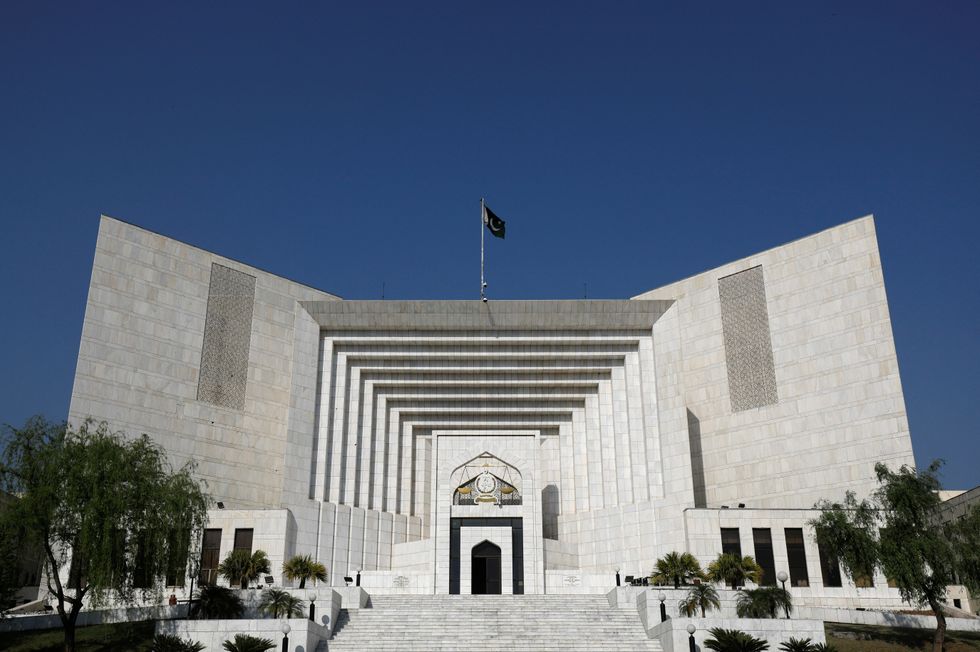
Pakistan’s top court questioned on Thursday whether the May 9 incidents were more severe than past acts of terrorism as it heard intra-court appeals challenging the trial of civilians in military courts.
The violence on May 9, 2023, erupted after the brief detention of former prime minister Imran Khan on graft charges. Individuals carrying Pakistan Tehreek-e-Insaf (PTI) flags vandalized government buildings and military installations, including setting fire to the official residence of a senior Pakistani general.
PTI has denied any role in the unrest, insisting that neither its leaders nor supporters orchestrated the riots. The party has also condemned a sweeping state crackdown, which it claims is politically motivated and aimed at dismantling PTI.
Last month, Khan and several PTI leaders were formally charged in connection with the attack on Pakistan’s military headquarters (GHQ).
A seven-member constitutional bench, led by Justice Aminuddin Khan, heard arguments from Khawaja Haris, counsel for the Ministry of Defense.
During the proceedings, Justice Hassan Azhar Rizvi raised a pointed question about the severity of the May 9 violence compared to past terrorist attacks.
He cited the assaults on the Mehran and Kamra airbases and the attack on Pakistan’s military headquarters (GHQ), asking where the trials for those cases were conducted.
“Pakistan suffered losses worth billions when two Orion aircraft were destroyed,” Justice Hassan said. “Was the May 9 incident graver than these acts of terrorism?”
Khawaja Haris responded that all the attackers involved in the Mehran base attack were killed. Justice Hassan, however, pressed further, questioning whether authorities investigated their identities and origins.
He noted that an attack’s file should not simply be closed because the perpetrators were killed. Haris admitted that investigations were likely conducted but pointed out that the GHQ attack case was tried in military courts before the 21st Constitutional Amendment.
The discussion then turned to the legality of military trials. Justice Jamal Mandokhail emphasized that courts established under Article 175 of the Constitution have broad jurisdiction, while those created under specific laws have limited authority. He noted that the 21st Amendment explicitly stated that military courts were formed in a wartime scenario and that a constitutional amendment was required to try civilians.
Haris, however, argued that no such amendment was necessary, stating that the Army Act had been amended to include additional offenses, allowing for the trials.
Meanwhile, Balochistan government’s lawyer, Sikandar Mehmood, backed the defense ministry’s arguments. This prompted Justice Mandokhail to question his authority to represent the provincial government. “If private lawyers are to represent the government, then the Advocate General’s office might as well be shut down,” he remarked, adding that the Balochistan government first needed to establish its standing in the case.
Advocate Ahmed Hassan, representing former Chief Justice Jawad S. Khawaja, argued that the petitioners had never sought acquittal for those accused of the May 9 incidents. “The sole contention,” he stressed, “is that civilians should not be tried in military courts.” He questioned why the government placed more trust in military courts than civilian judicial institutions.
Justice Mandokhail countered that similar objections could be raised from the opposite side as well.
Justice Musarrat Hilali emphasized that the Constitution remains the supreme law of the land, questioning why military and civilian personnel should be treated differently in legal proceedings. Justice Mandokhail noted that cases involving civilians killed by Rangers in Karachi and Turbat were tried in civilian courts.
Advocate Khawaja Ahmed Hussain argued that applying the Army Act to civilians effectively suspends fundamental rights. He compared the situation to that of Indian spy Kulbhushan Jadhav, who was granted the right to appeal in a high court through special legislation, whereas Pakistani civilians are being denied the same right.
The hearing was adjourned until the following day, with Advocate Khawaja Ahmed Hussain set to continue his arguments.
Leave a Reply