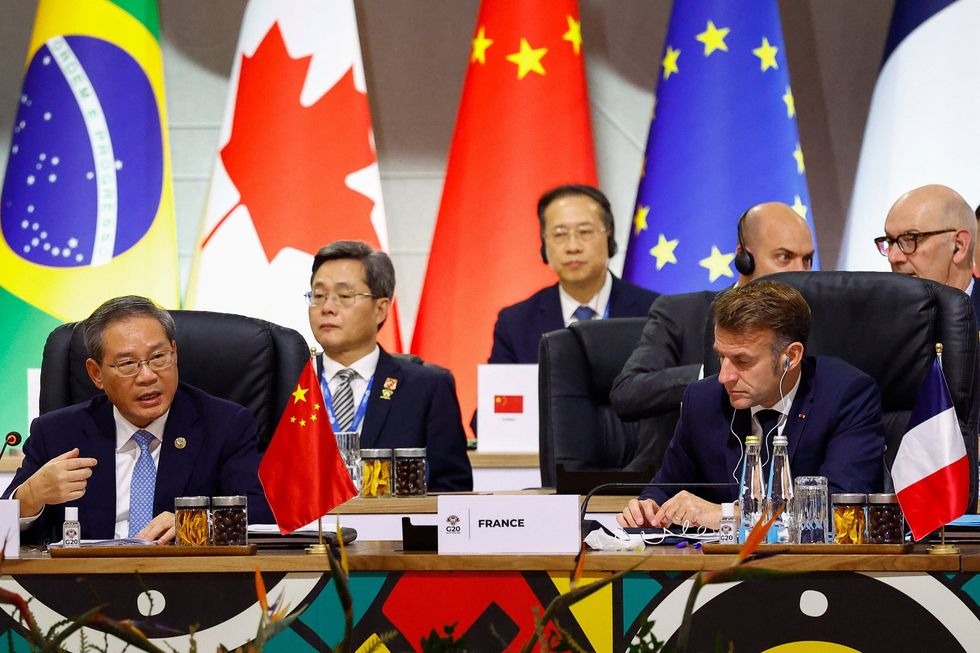
French President Emmanuel Macron will travel to China from December 3 to 5 for his fourth state visit, as Europe tries to balance mounting economic and security concerns about Beijing with its deep reliance on the world’s second-largest economy during a period of global trade volatility.
Macron has long sought to present a unified European posture toward China while avoiding overt confrontation with Beijing, whose increased assertiveness is straining diplomatic, trade, and security ties.
“He must make clear to China’s leadership that Europe will respond to growing economic and security threats from Beijing, while preventing an escalation of tensions that leads to a full-blown trade war and diplomatic breakdown,” said Noah Barkin, a China analyst with Rhodium Group. “This is not an easy message to deliver.”
Chinese exports hitting European industry
Macron will begin his visit on Wednesday at Beijing’s Forbidden City before meeting President Xi Jinping on Thursday in the capital and again Friday in Chengdu, in Sichuan province.
The trip will follow a tense July visit by European Commission President Ursula von der Leyen, who warned that EU-China relations were at an “inflection point.” British Prime Minister Keir Starmer and German Chancellor Friedrich Merz plan trips early next year.
Trade frictions have intensified as low-priced Chinese exports, especially steel, have been diverted from the U.S. market, hit European producers.
European officials are also increasingly alarmed by China’s technological lead in electric vehicles and its dominance in rare-earth processing, critical to key EU industries.
With U.S. tariffs disrupting global commerce, Beijing has been positioning itself as a partner for European businesses while trying to ease concerns over its support for Russia and its heavily subsidized industrial model.
Macron’s advisers said he will press for a rebalancing of trade, urging China to boost domestic consumption and share “gains from innovation” to help secure greater European access to Chinese technology.
EU preparing tougher trade approach
To address growing unease, the EU is set to introduce a new economic security doctrine that could see the bloc use its trade tools more aggressively toward China.
France, whose automakers have minimal market share in China but face pressure as they transition to EVs, supported the Commission’s effort to raise tariffs on Chinese electric vehicles.
Paris also spent more than a year in a dispute with Beijing over a Chinese probe into French brandy imports, widely viewed as retaliation for the EV tariff push, before tensions eased.
Despite Airbus recently opening a new assembly line in China, industry sources say the long-anticipated order of up to 500 aircraft is unlikely to be finalized during Macron’s visit. Such purchases give Beijing leverage as Washington pushes for renewed Boeing orders.
Macron seeks to avoid past missteps
Macron will also be wary of repeating errors from his 2023 trip, when comments on Taiwan during his flight home drew backlash in the United States.
“Macron cannot allow himself to go rogue as in 2023,” Barkin said, noting that his remarks, which appeared to signal neutrality between China and the U.S., “painted a misleading picture about where French policy towards China really was.”
French officials say Macron will emphasize maintaining the status quo in the Taiwan Strait and press Beijing to avoid escalation, following recent Japanese statements on the island that prompted a diplomatic spat with China.
“I expect him to be more disciplined this time,” Barkin said. “There is much more at stake for France and for Europe.”
Leave a Reply