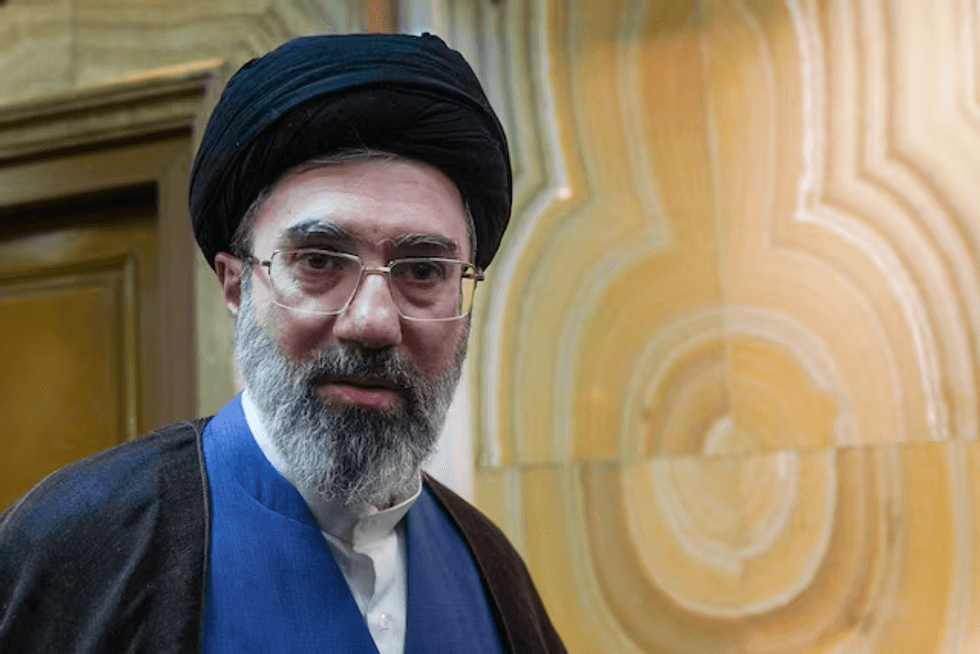
Iran’s supreme leader Ayatollah Mojtaba Khamenei declared Thursday that the United States had suffered a “disgraceful defeat” in its campaign against Iran.
The statement, read on state television, came as Trump signaled the naval blockade of Iran’s ports could last months, driving oil prices to their highest level in four years.
What did Iran’s supreme leader say about the US defeat?
Khamenei said that two months after what he called the “largest military deployment and aggression by the world’s bullies in the region,” a new chapter was unfolding for the Persian Gulf and the Strait of Hormuz.
He described Washington’s plans as having ended in disgrace, framing the standoff as a strategic victory for Tehran.
How has Iran responded to the US naval blockade?
Iranian President Masoud Pezeshkian said the blockade, which began April 13, violated international law and was destined to fail.
“Any attempt to impose a maritime blockade or restrictions is contrary to international law and is doomed to fail,” Pezeshkian said. He warned the restrictions would destabilize the wider Persian Gulf region.
Parliament speaker Mohammad Bagher Ghalibaf echoed those warnings on Wednesday, accusing Washington of using the blockade to sow internal division and force Iran to collapse from within. Iranian officials have consistently framed the confrontation as a failed American strategy, both for domestic audiences and internationally.
What impact has the blockade had on oil prices?
Oil markets reacted sharply to the escalating confrontation. Brent crude for June delivery rose 7.1% to more than $126 a barrel, reaching a four-year high. The Strait of Hormuz, through which about one-fifth of global oil supply typically passes, sits at the centre of the dispute.
U.S. Central Command said Wednesday it had redirected 42 commercial vessels attempting to breach the blockade. It added that 41 tankers carrying 69 million barrels of oil, valued at more than $6 billion, had been unable to sell their cargo.
What is Trump’s strategy in the standoff with Iran?
Trump has told oil executives and national security officials to prepare for a prolonged blockade aimed at forcing Tehran to abandon its nuclear program, according to Axios. He was also expected Thursday to receive a military briefing on Iran from Admiral Brad Cooper, head of U.S. Central Command. “They are choking like a stuffed pig. And it is going to be worse for them,” Trump said, per the report.
The Trump administration has insisted Iran’s nuclear program must be part of any negotiations. U.S. officials have also said they are uncertain who is representing Iran in potential talks, citing divisions between the Revolutionary Guards and diplomats following Israeli strikes that killed several senior leaders.
How is the conflict affecting Iran’s economy and regional stability?
Iran’s rial has fallen to historic lows against the dollar, reflecting the pressure the blockade has placed on the country’s economy. Tehran has sought leverage by tightening its grip on the Strait of Hormuz, proposing to ease restrictions if Washington lifts the blockade and agrees to broader negotiations.
The conflict has also generated domestic pressure on Trump, raising costs for American consumers and unsettling U.S. allies. On the Lebanese front, violence has continued despite an extended ceasefire between Israel and Hezbollah.
The Lebanese army said Israeli strikes this week killed one soldier and wounded two others in southern Lebanon, while Lebanese President Joseph Aoun said Israel must fully implement the ceasefire before negotiations can proceed. A United Nations-backed report found more than 1.2 million people in Lebanon face acute hunger due to the ongoing conflict.
Leave a Reply