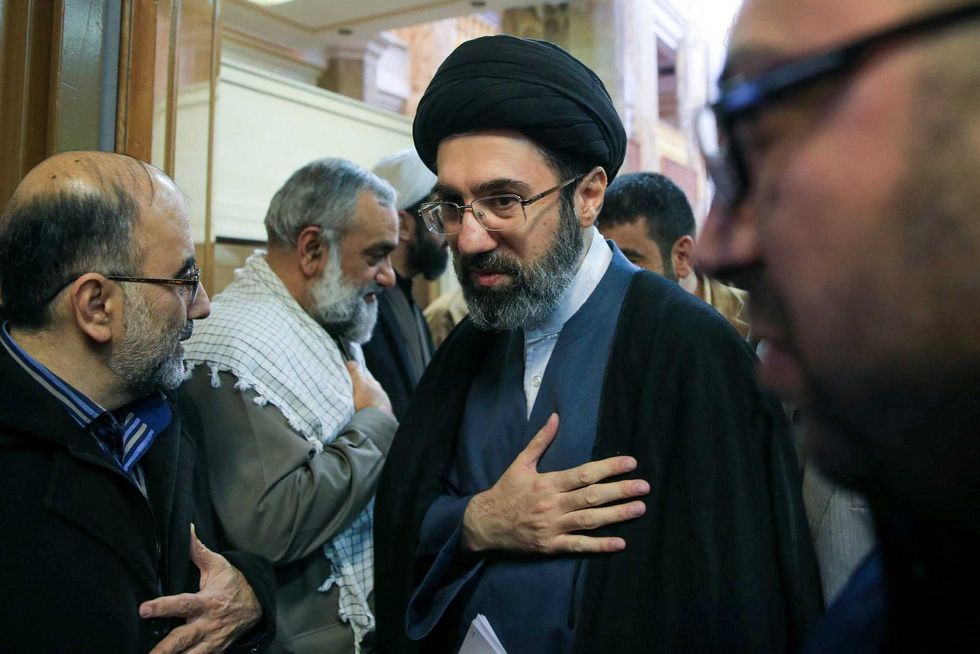
Iran’s newly appointed supreme leader, Mojtaba Khamenei, is “safe and sound” despite reports of injury during the ongoing war with Israel and the United States, his government adviser Yousef Pezeshkian said Wednesday.
“I heard news that Mr. Mojtaba Khamenei had been injured. I asked some contacts, and they confirmed he is safe and sound, thank God,” Pezeshkian wrote on his Telegram channel.
Earlier, state television described Khamenei as a “wounded veteran of the Ramadan war” but did not specify the nature of any injury. The 56-year-old, son of Iran’s late longtime ruler Ayatollah Ali Khamenei – who was killed in U.S.-Israeli strikes on February 28 – has yet to make a public statement or address the nation since being declared supreme leader on Sunday.
In a Wednesday report, the New York Times, citing three unnamed Iranian officials, said Khamenei “suffered injuries, including to his legs, but is alert and sheltering at a highly secure location with limited communication.”
Iran retaliates against US-Israeli strikes
Amid the U.S.-Israeli offensive, Iran launched attacks on Israel and Gulf states Wednesday, including strikes on a Saudi oilfield. A military-affiliated news outlet quoted armed forces spokesperson Abolfazl Shekarchi as saying Iran would continue retaliating and urged regional countries and fellow Muslims to report “U.S.-Zionist (Israeli) hiding places” to enhance strike precision while minimizing civilian casualties, whom he described as “used as human shields.”
The conflict, triggered by the February 28 strikes, has spread across the Middle East, driving up energy costs, prompting fuel rationing, and forcing school closures in several countries.
In response, G7 leaders are set to meet via video conference Wednesday to discuss the war’s economic fallout, particularly global energy markets, while the International Energy Agency considers a proposal for its largest-ever release of oil reserves, according to the Wall Street Journal.
US strikes and Strait of Hormuz tensions
The United States on Tuesday said it targeted Iranian ships capable of mining the Strait of Hormuz, a critical oil passage threatened by Tehran. The U.S. military released footage showing 16 Iranian minelaying vessels destroyed near the strait, through which roughly one-fifth of the world’s oil flows.
“If for any reason mines were placed, and they are not removed immediately, the military consequences to Iran will be at a level never seen before,” President Donald Trump wrote on social media.
Trump faces mounting political pressure amid rising oil prices ahead of U.S. elections. Crude surged five percent late Tuesday before easing Wednesday following reports of a potential oil reserve release. While Trump suggested the military could escort tankers through the strait, officials later clarified that an initial announcement of such a mission was inaccurate.
Early Wednesday, the UK maritime agency reported that a container ship off the UAE coast had been hit by an “unknown projectile,” highlighting ongoing risks to regional shipping.
Escalating conflict across the region
Iranian authorities have emphasized they are not seeking a ceasefire. Iranian parliament speaker Mohammad Bagher Ghalibaf, a former Revolutionary Guards commander, said on X: “Certainly we aren’t seeking a ceasefire. The aggressor must be punished and taught a lesson to deter future attacks.”
The government also announced its most intense salvo yet, firing missiles for three hours at cities across Israel. AFP journalists reported air raid sirens and explosions in Jerusalem, while emergency services said no immediate injuries were reported, though Channel 12 cited several casualties in Tel Aviv.
Iran’s Revolutionary Guards additionally targeted Bahrain, Iraqi Kurdistan, and a U.S. air base in Kuwait. Kuwaiti authorities said they intercepted eight drones, and Saudi Arabia reported several drones aimed at the Shaybah oil field were destroyed.
Since the conflict began, seven U.S. military personnel have been killed, with around 140 injured, according to the Pentagon.
Impact on civilians and global markets
In Tehran, residents described fear and disruption from airstrikes. One woman said she found some reassurance in the impression that ordinary buildings were not targeted but added, “The noise of the bombings is extremely disturbing.” Iran’s health ministry reported over 1,200 deaths and more than 10,000 civilian injuries as of March 8.
The conflict has spread internationally. In Sri Lanka, U.S. forces torpedoed an Iranian ship, and Australia granted asylum to two additional members of the Iranian women’s football team. Iraq and Lebanon, home to Iran-backed militias, have become key proxy battlegrounds. Iranian-linked groups reported five fighter deaths in Iraq, attributed to U.S. strikes. In Lebanon, hundreds have been killed and hundreds of thousands displaced following Israeli air and ground operations targeting Hezbollah positions.
New Israeli strikes on Wednesday hit southern Beirut, including Qana, where five people were killed, and central Beirut, hitting a seafront hotel where four Iranian diplomats died in a previous strike. Israel said the target was Revolutionary Guards commanders.
The war’s effects are being felt worldwide. The UN trade and development agency warned that rising fuel and food costs are hitting the most vulnerable populations. In Egypt, where fuel prices rose up to 30 percent, residents expressed concern about managing daily life amid the escalating costs.
Leave a Reply