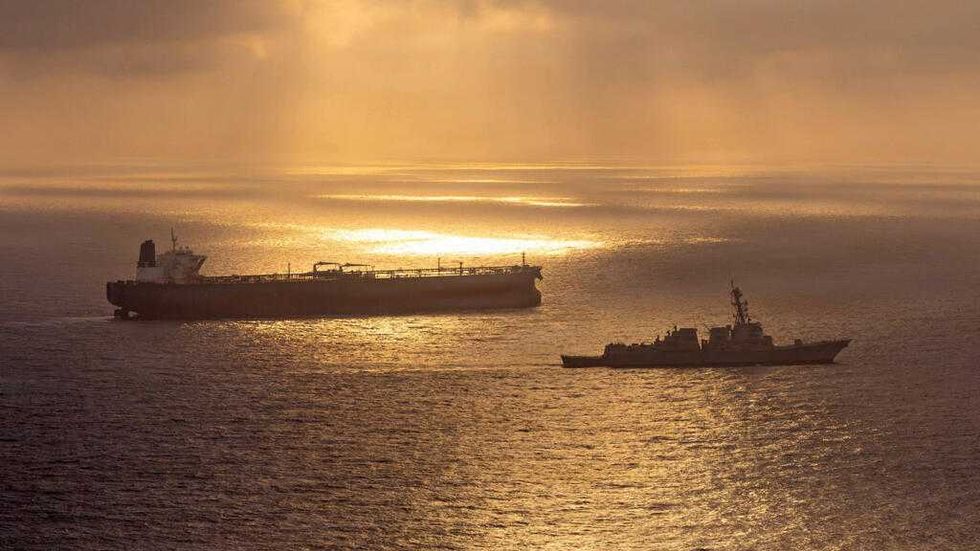
Iran’s Islamic Revolutionary Guards Corps threatened Saturday to strike US sites in the Middle East if Iranian tankers come under further attack, state media reported.
The warning came a day after US fighter jets disabled two Iranian-flagged tankers in the Gulf of Oman and as Washington waited for Tehran’s response to its latest peace proposal.
What did Iran’s Guards threaten against US sites?
The Guards said any attack on Iranian tankers or commercial vessels would trigger a retaliatory strike on American military sites and ships in the region. The warning followed reported US strikes on two Iranian tankers in the Gulf of Oman on Friday. An Iranian military official said the navy had already responded with strikes of its own.
What is the current status of US-Iran peace talks?
President Donald Trump said Friday he expected Iran’s answer to Washington’s latest negotiating proposal “supposedly tonight.” But no public response emerged, and a French journalist reported Saturday that Trump said he still expected to hear back “very soon.”
Iran’s foreign ministry spokesman said the proposal remained “under review.”
Iran’s Foreign Minister Abbas Araghchi cast doubt on American intentions, telling his Turkish counterpart that recent US military actions in the Persian Gulf had raised suspicions about Washington’s seriousness in pursuing diplomacy.
His remarks were reported by Iran’s ISNA news agency. The comments reflected growing frustration on the Iranian side despite continued back-channel contact.
Washington transmitted its proposal to Iran via Pakistani mediators. The offer seeks to extend a Gulf ceasefire to allow negotiations on a final settlement to the conflict, which began 10 weeks ago with US-Israeli strikes on Iran.
Who is mediating between Washington and Tehran?
Pakistan has taken a leading role in shuttling proposals between the two sides. Qatar is also playing a key intermediary role.
Secretary of State Marco Rubio met Saturday with Qatar’s leader, Sheikh Mohammed bin Abdulrahman Al Thani, to discuss coordination on regional stability.
The Qatari leader had met US Vice President JD Vance the previous day to discuss the Pakistani-led peace effort.
Iran attacked sites in Qatar during the war, a pointed reminder of the emirate’s exposed position as host of a major US air base while serving as a diplomatic go-between.
What caused the oil slick near Iran’s Kharg Island?
Satellite images showed an apparent oil slick spreading off the west coast of Kharg Island, Iran’s principal oil export terminal. Global monitor Orbital EOS estimated the slick covered more than 20 square miles.
The cause was not immediately clear, though the UK-based Conflict and Environment Observatory told AFP the slick had reduced significantly by Saturday and may have resulted from leaking oil infrastructure.
Kharg Island sits far north of the Strait of Hormuz in the Gulf and is central to Iran’s oil export economy. Following the start of the war on Feb. 28, Iran largely closed the strait, sending global oil markets into turmoil.
The US later imposed its own blockade of Iranian ports, and Trump this week abandoned a short-lived naval operation to reopen the strait to commercial shipping.
What is happening on the Lebanon front of the conflict?
A separate ceasefire on the conflict’s Lebanon front showed fresh signs of strain Saturday. Israeli strikes killed at least nine people in southern Lebanon, while air raids also targeted a highway south of Beirut, outside Hezbollah’s traditional strongholds.
The attacks were among the most intense since a three-week-old ceasefire between Israel and Hezbollah took effect.
Hezbollah said it launched drones at troops in northern Israel on at least two occasions in response. Israel’s military confirmed several explosive drones entered its territory, leaving one army reservist severely wounded and two others moderately injured.
Lebanon and Israel, officially at war since 1948, are scheduled to hold direct negotiations in Washington next week, which Hezbollah has strongly opposed.
Leave a Reply