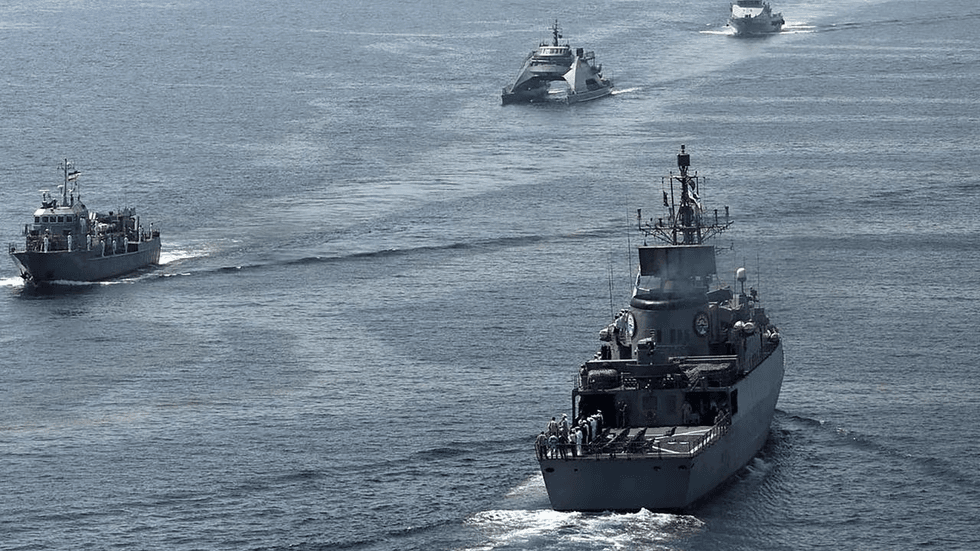
A senior Iranian lawmaker said on Thursday that Tehran has received its first revenue from tolls imposed on shipping through the strategic Strait of Hormuz during its conflict with the United States and Israel.
“The first revenue from the Strait of Hormuz tolls has been deposited into the Central Bank account,” deputy parliament speaker Hamidreza Hajibabaei said, according to Tasnim news agency. Other Iranian media carried the statement without further detail.
The Strait of Hormuz, a key global energy chokepoint, has emerged as a major flashpoint since the outbreak of the Middle East conflict on February 28. In peacetime, the waterway carries about one-fifth of the world’s oil and gas supplies.
Since the escalation, Iran has restricted traffic through the strait, allowing only limited passage, while warning that maritime flows would not return to pre-war levels.
Before announcing the toll revenue, Iranian lawmakers had been weighing the imposition of fees on vessels transiting the strait. State media reported on March 30 that parliament’s security commission approved the proposal, though it remains unclear whether a final vote has been held.
The United States has urged Iran to reopen the waterway, while Britain and France, along with military planners from more than 30 countries, have discussed measures to safeguard navigation. Paris and London have said they are prepared to lead a multinational maritime mission when conditions permit.
The toll announcement comes amid continued tensions around the strait despite an ongoing ceasefire, with both sides maintaining pressure through economic and maritime measures.
Iran has said it will not reopen the route as long as U.S. restrictions on its maritime trade remain in place, linking the issue directly to broader negotiations.
While active hostilities have largely subsided under the truce, the standoff over shipping routes underscores the fragile nature of the ceasefire and the absence of a broader agreement.
With the ceasefire due to expire earlier this week, U.S. President Donald Trump announced a last-minute indefinite extension to allow more time for Pakistan-mediated peace efforts.
Tehran welcomed Pakistan’s role but did not explicitly endorse the extension. Iranian parliament speaker Mohammad Bagher Ghalibaf said a ceasefire would only be meaningful if it is not undermined by what he described as a naval blockade.
“A complete ceasefire only has meaning if it is not violated through a naval blockade,” he said, adding that reopening the Strait of Hormuz was not possible under current conditions.
Oil prices rose earlier on Thursday before easing, reflecting uncertainty over the diplomatic outlook.
Trump told the New York Post that talks could resume in Pakistan within days, although Iran has not confirmed participation. U.S. Vice President JD Vance has delayed a planned visit to Islamabad.
Separately, Trump said Iran had halted plans to execute eight women detained during recent anti-government protests at his request. Iran’s judiciary dismissed the claim as “false,” saying the women had never faced the death penalty.
Ships seized
Amid the ongoing tensions, Iran’s Revolutionary Guards said they had intercepted two commercial vessels in the Strait of Hormuz and directed them toward Iranian waters.
“The Islamic Revolutionary Guard Corps naval force identified and stopped two violating ships in the Strait of Hormuz,” the Guards said in a statement, naming them as the Panama-flagged MSC Francesca and the Liberia-flagged Epaminondas.
Panama’s foreign ministry confirmed the seizure of MSC Francesca, describing it as a “serious attack on maritime security” and an escalation.
Maritime security monitors also reported multiple incidents involving commercial vessels in the strait. The UK Maritime Trade Operations (UKMTO) said one container ship reported being fired upon by a Revolutionary Guards vessel northeast of Oman, causing damage but no casualties.
U.S. Central Command said on X that since the start of U.S. maritime restrictions on Iran, its forces had directed 31 vessels to turn back or return to port, underscoring the scale of enforcement efforts.
Under orders from Trump, the U.S. Navy has sought to block vessels linked to Iranian ports as part of broader economic pressure measures.
In a separate development, the Pentagon said Navy Secretary John Phelan would leave his post “immediately,” without providing a reason, marking the latest senior departure under Defense Secretary Pete Hegseth.
The U.S. military also said it had intercepted and boarded a “stateless sanctioned” vessel linked to Iranian activity. Both Washington and Tehran continue to accuse each other of violating the ceasefire.
Lebanon-Israel talks
Following the Iran ceasefire, the United States also helped broker a truce between Israel and Lebanon, including Hezbollah, the Iran-backed group that had launched attacks on Israel during the conflict.
Despite the truce, violence has persisted, with Lebanese media reporting that Israeli strikes killed five people on Wednesday.
Among the casualties was journalist Amal Khalil of Al-Akhbar, while another reporter, Zeinab Faraj, was wounded in a strike near the border, the newspaper said.
Israel and Lebanon are due to hold a second round of talks in Washington on Thursday, despite having no formal diplomatic relations.
A Lebanese official said Beirut would seek a one-month extension of the ceasefire, along with an end to Israeli strikes and destruction in affected areas.
The conflict has killed more than 2,450 people in Lebanon since it began, according to Lebanese authorities.
Leave a Reply