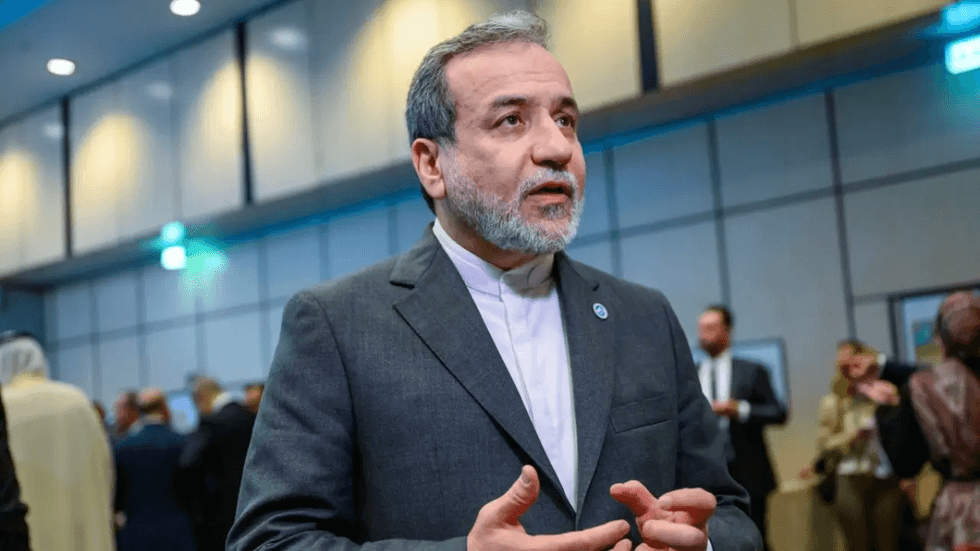
Iranian Foreign Minister Abbas Araghchi on Monday blamed the United States for the failure of peace talks in Pakistan, after arriving in Russia for a meeting with President Vladimir Putin.
“The US approaches caused the previous round of negotiations, despite progress, to fail to reach its goals because of the excessive demands,” Araghchi was quoted as saying by Iranian state media.
He also said that “safe passage through the Strait of Hormuz is an important global issue”, as the US and Iran continue their rival blockades in the waterway.
Araghchi arrived in Saint Petersburg on Monday for talks with Russian President Vladimir Putin, following a series of shuttle diplomacy efforts across the region that failed to produce a breakthrough with Washington.
The visit comes after stops in Oman and Islamabad, where regional mediators had attempted to keep US-Iran contacts on track. However, planned engagement in Pakistan faltered after Washington cancelled a proposed visit by US envoys Steve Witkoff and Jared Kushner, following signals that Tehran was unwilling to proceed under current conditions.
Backchannel messaging continues despite breakdown
Despite the setback, indirect communications have continued. Iran’s Fars news agency reported that Tehran had sent written messages to the United States via Pakistani intermediaries outlining its red lines, including on nuclear issues and the Strait of Hormuz, while stressing these were not formal negotiations.
Separately, Axios reported that Iran had submitted a new proposal through intermediaries suggesting a phased approach in which disputes over the Strait of Hormuz and ceasefire arrangements would be addressed first, with nuclear talks deferred to a later stage. Iranian state media cited the report without dispute.
Strait tensions and ceasefire fragility
A ceasefire linked to the wider US-Israeli-Iran confrontation has so far held, but its economic and geopolitical repercussions continue to spread, particularly through energy markets.
Iran has tightened restrictions around the Strait of Hormuz, disrupting flows of oil, gas and fertilizer and contributing to price volatility, while Washington has maintained pressure through its own maritime measures, deepening uncertainty over global supply routes.
US President Donald Trump has said Iran could engage directly with Washington if it wants to continue talks, signaling frustration with the current mediation process and shifting diplomatic responsibility back to Tehran.
Trump is also facing domestic political pressure as energy prices rise amid supply disruptions, with public opposition to renewed conflict reportedly growing ahead of upcoming electoral cycles.
Meanwhile, Iran’s Revolutionary Guards have signaled no intention of easing their position on maritime leverage, framing control of the Strait of Hormuz as a strategic deterrent.
Wider regional spillover continues in Lebanon
Separately, tensions between Israel and Hezbollah have escalated despite a fragile ceasefire framework in Lebanon, with both sides accusing each other of violations and continuing military action.
Lebanese authorities reported civilian casualties following Israeli strikes in the south, while Israel said it was responding to threats and maintaining operational freedom to act against what it describes as imminent risks.
Leave a Reply