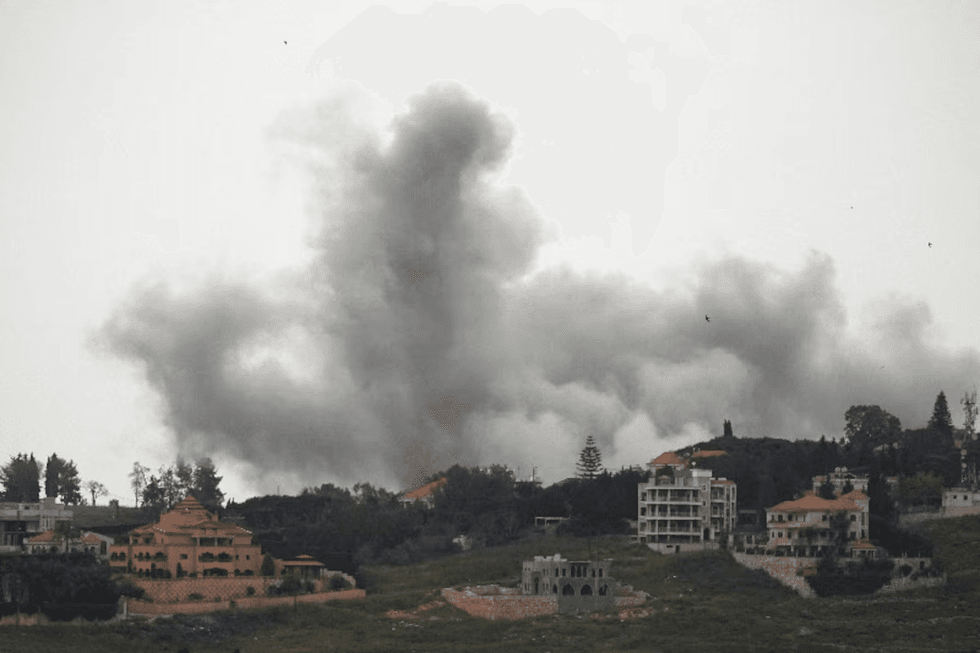
Israeli strikes pounded south and east Lebanon on Sunday despite an active ceasefire, killing at least 13 people across multiple locations. Lebanon’s health ministry raised the overall war toll to 3,123 killed since fighting began on 2 March.
The strikes came as Hezbollah‘s chief expressed hope that a U.S.-Iran agreement would bring a full halt to hostilities, including in Lebanon.
What is happening between Israel and Lebanon right now?
Israel has continued striking what it describes as Hezbollah targets across south and east Lebanon despite a ceasefire that began on 17 April and was recently extended for several weeks.
Lebanon’s health ministry reported two people killed on Sunday, including a paramedic from the Hezbollah-affiliated Islamic Health Committee. Hezbollah has also maintained attacks on Israeli troops and cross-border targets.
How many people have been killed in the latest Israeli strikes on Lebanon?
Lebanon’s health ministry confirmed two deaths on Sunday from Israeli raids. A day earlier, 11 people, including six women and a child, were killed in a single strike on Sir al-Gharbiyeh in the south, which the ministry described as a “massacre.”
Lebanon’s official National News Agency reported Israeli airstrikes on more than 30 locations across south and east Lebanon on Sunday, some causing casualties.
Lebanon’s civil defense agency said its regional facility in Nabatieh was destroyed in an overnight Israeli strike. An AFP photographer saw civil defense personnel recovering equipment from the rubble. Israel’s military did not respond to an AFP inquiry about the strike.
Why is Israel still striking Lebanon during the ceasefire?
Under the ceasefire terms published by Washington, Israel reserves the right to act against “planned, imminent or ongoing attacks.” Israeli military chief Lieutenant General Eyal Zamir said the military would “continue to strike Hezbollah across all dimensions,” adding that civilian security and troop safety remained the priority. Israeli troops operating inside Lebanon are also active within a self-declared “yellow line” running roughly 10 kilometers deep along the southern border.
Israel also issued evacuation warnings for more than a dozen villages in Lebanon’s south and the eastern Bekaa valley on Sunday. Hezbollah claimed more than 20 attacks on Israeli forces on the same day, using rockets, attack drones and artillery. AFP correspondents saw large clouds of smoke rising after strikes in several locations.
What did Hezbollah’s chief say about the Iran-U.S. deal?
Hezbollah leader Naim Qassem said he hoped a U.S.-Iran agreement would be finalized and that Lebanon would be included in any full cessation of hostilities. He again rejected direct talks between Israel and Lebanon, telling Lebanese authorities: “Abandon the direct negotiations. Don’t be with them and stab us in the back.” Lebanese authorities recently began landmark direct talks with Israel under U.S. auspices and are preparing for a fourth round in early June.
Qassem also said that “disarmament is annihilation and we cannot accept it,” adding that his group faced an existential threat. After his speech, U.S. Secretary of State Marco Rubio accused Hezbollah of trying to push Lebanon “back into chaos.”
Iran has indicated that any understanding with Washington to halt the regional war would include Lebanon, but Israeli Prime Minister Benjamin Netanyahu said Trump had reaffirmed Israel’s right to defend itself “against threats on all fronts, including in Lebanon.”
Hezbollah drew Lebanon into the wider Middle East war on 2 March with rocket fire at Israel, in retaliation for the killing of Iran’s supreme leader in U.S.-Israeli strikes. A military delegation meeting at the Pentagon is scheduled for 29 May, ahead of a fourth round of Israel-Lebanon talks in early June.
Leave a Reply