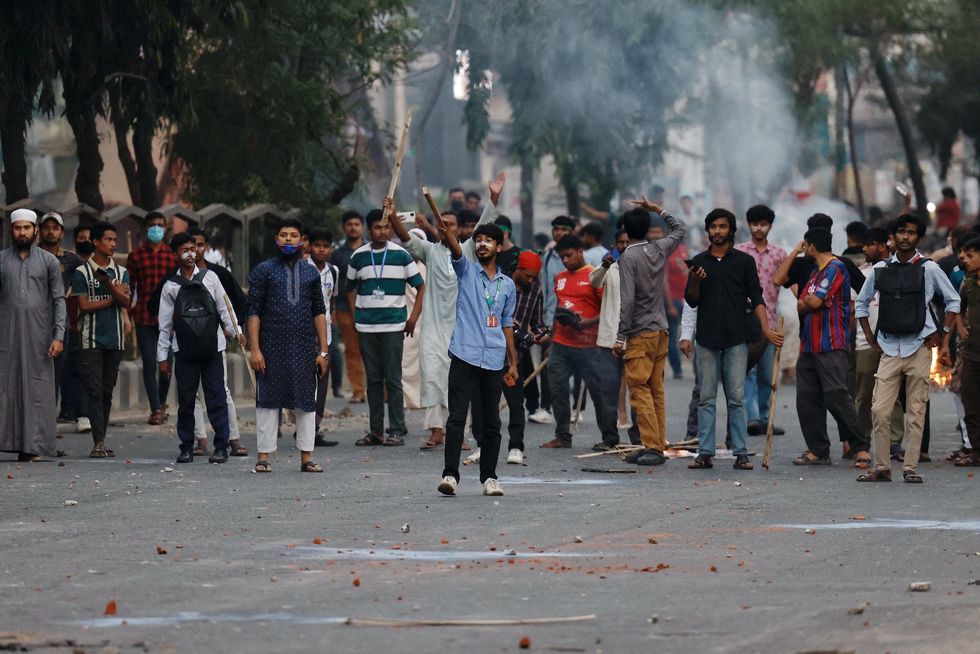
Thousands in Bangladesh flocked to hear the plans of the students who toppled long-time leader Sheikh Hasina when they launched a new political party this year. But the group is now struggling to turn its street power into votes.
Fighting to deliver on its promise to free the nation from decades of nepotism and two-party dominance, the student-run National Citizen Party, or NCP, faces entrenched rivals with deep networks and money as February polls near.
“Our organization is weak because we haven’t had enough time to build it,” said its chief, Nahid Islam, a prominent figure in last year’s deadly anti-government protests who briefly served in the caretaker administration under Nobel laureate Muhammad Yunus.
“We are aware of this, but we are still taking on the challenge,” added the 27-year-old, speaking from the party’s Dhaka office, where a wall is covered in graffiti showing crowds in revolt.
Polls push NCP to third
Opinion surveys show the NCP, which plans to contest all 300 seats, in third place with just 6% support, far behind the Bangladesh Nationalist Party of former Prime Minister Khaleda Zia, which leads with 30%.
Even the hardline Jamaat-e-Islami is projected to do better, coming in second with 26%, according to a December poll by the U.S.-based International Republican Institute.
“When they first launched, I saw hope in them, like everyone,” said Prapti Taposhi, 25, who helped lead the revolt and initially looked to the newcomers to break decades of rule by the two dominant parties. She later grew disappointed.
“They say they are centrist, but their actions don’t match that,” the feminist activist added. “They hesitate to take positions on important issues, whether it’s minority rights or women’s rights, and when they do, it comes too late.”
Another sign of disenchantment emerged in September, when the party failed to win a single seat in Dhaka University’s student body election, despite the campus being the epicentre of the uprising.
Hasina’s Awami League, barred from contesting the national vote, has warned of unrest if the ban is not removed, a threat that could endanger Bangladesh’s massive garment sector, the world’s second-largest exporter.
Alliance talks
Hampered by a skeletal structure, scarce funds and positions on rights issues widely seen as unclear, the NCP is holding talks with other parties, including the BNP and Jamaat-e-Islami, leaders say.
“If we stand independently, there is a chance we may not win even one seat,” a senior NCP figure told Reuters on condition of anonymity, acknowledging the risks involved.
Analysts say joining forces could undercut the party’s image as a revolutionary alternative. “If they ally, the public will no longer see them as a distinct force outside the Awami League, BNP and Jamaat,” said Dhaka-based writer and political analyst Altaf Parvez.
Although the uprising briefly unified students across party lines to push Hasina from power, most later returned to their traditional groups, leaving only a fraction to build the NCP. Now the party faces rivals with long-standing machinery that reaches deep into rural districts.
Fundraising hurdles
Money remains a major obstacle, Islam said, as members rely on salaries from full-time jobs, small donations and crowdfunding to sustain their campaign.
Some, like 28-year-old Hasnat Abdullah, have taken to villages to drum up support. “In my constituency, I tell people I am penniless,” he said of the eastern region where he hopes to run. “I told them a leader’s main job is not to give voters money but to ensure government funds are allocated and used properly.”
Graft accusations against several NCP leaders, which the party denies, saying it has zero tolerance for corruption, have further dented its image.
Offering something new
Still, some young backers remain hopeful, drawn to the party’s calls for a more egalitarian culture in a political arena dominated by wealth, muscle and dynasties.
“They are young, they led the revolution, and I’m hopeful they can deliver change, as long as they don’t turn authoritarian themselves,” said university student Manzila Rahman.
The NCP launched an unusual candidate search in November, conducting interviews with more than 1,000 people over two days. Young leaders moved from booth to booth questioning hopefuls, including a rickshaw puller who took a day off work and a 23-year-old student partly blinded by police pellets during the protests.
“Some may think a rickshaw puller has nothing to offer in parliament,” said Sujan Khan, 32. “Give me a chance and see what I do to change the country.”
Such possibilities attracted Tasnim Jara, a doctor who left a successful career in Cambridge to join the NCP and help build it from scratch. “We want to open up politics, not keep it confined to powerful families, and give power back to ordinary people,” she said.
BNP and Jamaat leaders say they also see value in bringing students into mainstream politics. “It’s the young people who are going to dominate politics in the future, so it will be good if we can accommodate them in parliament,” said BNP leader Mirza Fakhrul Islam Alamgir.
NCP leaders say they are thinking beyond the upcoming vote, focusing on long-term institutional and structural reforms.
“Win or lose, just by taking part in the election, we are offering something new,” Abdullah said.
Leave a Reply