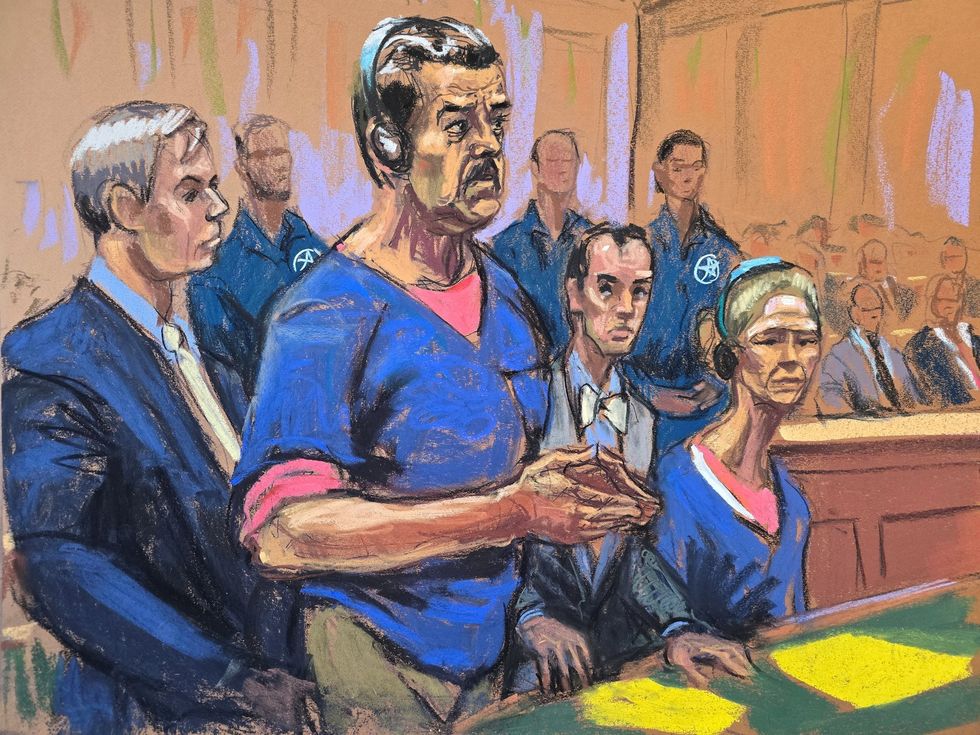
Ousted Venezuelan President Nicolás Maduro pleaded not guilty to drug trafficking and other charges during a defiant appearance in a New York court Monday, two days after U.S. forces seized him in a stunning raid on his home in Caracas.
Maduro, 63, told a federal judge in Manhattan, “I’m innocent. I’m not guilty.”
Smiling as he entered the courtroom and wearing an orange shirt with beige trousers, Maduro spoke softly.
“I’m president of the Republic of Venezuela, and I’ve here kidnapped since January 3, Saturday,” Maduro told the court, speaking in Spanish through an interpreter. “I was captured at my home in Caracas, Venezuela.”
But the man who ruled his oil-rich country with an iron fist for more than 12 years received a sharp reminder of his fall when the judge told him to limit his remarks to stating his name.
Maduro’s wife, Cilia Flores, also pleaded not guilty. The judge ordered both to remain jailed and scheduled a new hearing for March 17.
Thousands of people marched through Caracas in support of Maduro as his former deputy, Delcy Rodríguez, was sworn in as interim president.
But the Maduro era appears to be over.
The couple was forcibly taken by U.S. commandos early Saturday in airstrikes on the Venezuelan capital backed by warplanes and a heavy naval deployment.
In a series of shock announcements over the weekend, Trump then declared the United States was “in charge” and intended to take control of Venezuela’s vast but crumbling oil industry.
The 79-year-old president also rejected the idea of Venezuela holding new elections within the next month.
“We have to fix the country first. You can’t have an election. There’s no way the people could even vote,” Trump told NBC News in an interview aired Monday.
Access to oil
Maduro became president in 2013, succeeding his equally hard-line socialist predecessor Hugo Chávez.
The United States and European Union say he stayed in power by rigging elections — most recently in 2024 — and imprisoning opponents, while overseeing widespread corruption.
The crisis after a quarter century of leftist rule now leaves Venezuela’s roughly 30 million people facing uncertainty.
Trump has said he wants to work with Rodríguez and the rest of Maduro’s former team — provided they submit to U.S. demands on oil.
After an initially hostile response, Rodríguez said she was ready for “cooperation.”
Venezuela has the world’s largest proven oil reserves.
However, the oil is difficult and costly to extract, and after years of international sanctions and mismanagement, the infrastructure is in poor condition.
Markets finished higher Monday as shares in major U.S. oil companies Chevron, Exxon Mobil, and ConocoPhillips surged, with the Dow Jones index and London’s FTSE 100 closing at new all-time highs.
Brian Naranjo, a former U.S. diplomat in Venezuela before being expelled by Maduro in 2018, said he has “not been so worried about the future of Venezuela, ever.”
“There’s a very real possibility that things are going to get much, much worse in Venezuela before they get better,” he told AFP.
The former deputy head of the U.S. mission to Caracas from 2014 to 2018 pointed to two men who could try to seize power from Rodríguez: Interior Minister Diosdado Cabello and her brother, Jorge Rodríguez, the head of Venezuela’s legislature.
“Delcy had better be sleeping with one eye open right now because right behind her are two men who would be more than happy to cut her throat and take control themselves,” Naranjo said.
Cuba, Greenland next?
Trump, who has shocked many Americans with unprecedented moves to consolidate domestic power, also appears increasingly emboldened in foreign policy.
On Sunday, he said communist Cuba was “ready to fall” and again said Greenland, part of U.S. ally Denmark, should be controlled by the United States.
Brian Finucane of the International Crisis Group told AFP that Trump “seems to be disregarding international law altogether” in Venezuela and added that U.S. domestic law also appeared to have been violated.
Details of the U.S. operation in Caracas were still emerging Monday, with Havana saying 32 Cubans were killed in the attack.
U.S. Defense Secretary Pete Hegseth said nearly 200 personnel took part in the surprise raid. U.S. officials reported some injuries but no deaths.
Leave a Reply