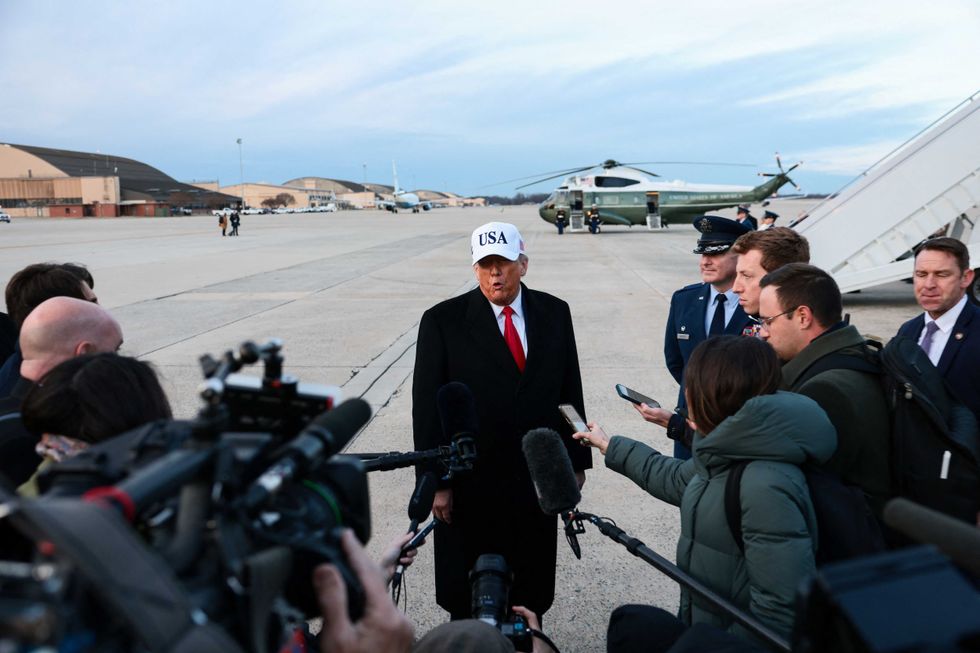
U.S. President Donald Trump warned Tuesday of unspecified “very strong action” if Iranian authorities proceed with threatened hangings of some protesters, as Tehran dismissed the American warnings as a “pretext for military intervention.”
International outrage has grown over the crackdown, which a rights group said has likely killed thousands during protests, posing one of the biggest challenges yet to Iran’s clerical leadership.
Iran’s mission to the United Nations posted a statement on X, vowing that Washington’s “playbook” would “fail again.”
“U.S. fantasies and policy toward Iran are rooted in regime change, with sanctions, threats, engineered unrest and chaos serving as the modus operandi to manufacture a pretext for military intervention,” the statement said.
Iranian authorities have insisted they regained control of the country after successive nights of nationwide protests that began Thursday.
Rights groups accuse the government of fatally shooting demonstrators and concealing the scale of the crackdown through an internet blackout that has now surpassed five days.
Trump, who earlier told protesters in Iran that “help is on its way,” told CBS News that the United States would act if Iran began hanging detainees.
Tehran prosecutors said authorities would pursue capital charges of “moharebeh,” or “waging war against God,” against some suspects arrested during recent demonstrations.
“We will take very strong action if they do such a thing,” Trump said, repeating threats of possible military intervention.
“When they start killing thousands of people, and now you’re telling me about hanging. We’ll see how that’s going to work out for them,” he said.
Videos circulating on social media, with locations verified by AFP, showed bodies lined up at the Kahrizak morgue south of Tehran, wrapped in black bags as anguished relatives searched for loved ones.
International phone connections were partially restored Tuesday, but only for outgoing calls, according to an AFP journalist, and service remained unstable with frequent interruptions.
Earlier Tuesday, Trump wrote on his Truth Social platform, urging Iranians to “KEEP PROTESTING,” adding: “I have cancelled all meetings with Iranian Officials until the senseless killing of protesters STOPS. HELP IS ON ITS WAY.”
It was not immediately clear what meetings he was referring to or what form the assistance would take.
Rising casualties
European nations also signaled anger over the crackdown. France, Germany, and the United Kingdom were among those that summoned Iranian ambassadors, as did the European Union.
“The rising number of casualties in Iran is horrifying,” EU Commission President Ursula von der Leyen said, pledging further sanctions against those responsible.
The Norway-based group Iran Human Rights said it had confirmed 734 deaths, including nine minors, but warned the toll was likely much higher.
“The figures we publish are based on information from fewer than half of the provinces and fewer than 10 percent of hospitals. The real number is likely in the thousands,” said IHR director Mahmood Amiry-Moghaddam.
The group highlighted the case of Erfan Soltani, 26, arrested last week in the Tehran suburb of Karaj and, according to a family source, already sentenced to death and facing execution as early as Wednesday.
Iranian state media have reported that dozens of security force members have been killed, with funerals turning into large pro-government rallies.
Authorities announced a mass funeral in Tehran on Wednesday for those described as “martyrs” of the unrest.
Amir, an Iraqi computer scientist who returned to Baghdad on Monday, described dramatic scenes in the capital.
“On Thursday night, my friends and I saw protesters in Tehran’s Sarsabz neighborhood amid a heavy military presence. Police were firing rubber bullets,” he told AFP.
Serious challenge
The government on Monday sought to reassert control with nationwide rallies that Supreme Leader Ayatollah Ali Khamenei hailed as proof the protest movement had been defeated, calling them a “warning” to the United States.
In power since 1989 and now 86, Khamenei has faced repeated challenges, most recently a 12-day war with Israel in June that killed senior security officials and forced him into hiding.
Analysts caution it is premature to predict the collapse of the theocratic system, citing the repressive tools available to the leadership, including the Revolutionary Guard Corps.
“These protests arguably represent the most serious challenge to the Islamic Republic in years, both in scale and in increasingly explicit political demands,” said Nicole Grajewski of the Sciences Po Centre for International Studies in Paris.
She said it remains unclear whether the protests will unseat the leadership, pointing to “the sheer depth and resilience of Iran’s repressive apparatus.”
Leave a Reply