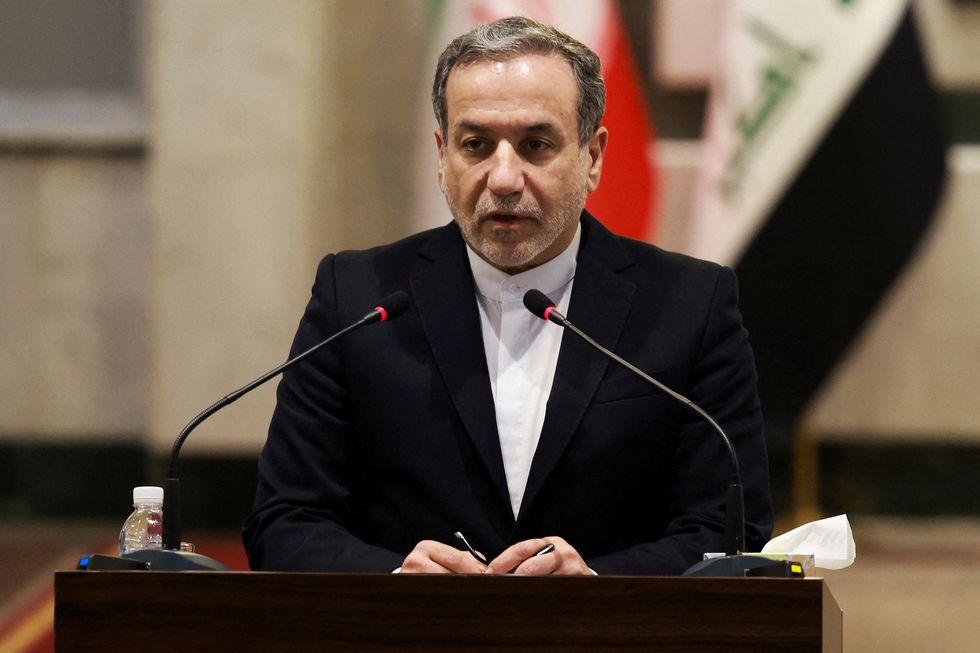
Iran’s foreign minister said Sunday that Tehran would welcome any initiative that could guarantee a complete end to the U.S.-Israeli war on Iran, as fighting between the sides continued and tensions spread across the Middle East.
Iranian Foreign Minister Abbas Araqchi said Tehran was in communication with several Gulf capitals and would support efforts aimed at halting the conflict, according to comments published on his Telegram channel and cited in an interview with the Al-Araby al-Jadeed website.
Araqchi also denied that Iran had targeted civilian or residential areas in the region and said Tehran was ready to establish a committee with neighboring countries to investigate responsibility for strikes that have hit Gulf states.
Several Gulf countries have called on Iran to stop attacks on their territories, saying the strikes have affected not only U.S. military bases but also energy facilities and residential areas.
The war between Iran, the United States and Israel has now entered its third week.
U.S. President Donald Trump warned of further military action and threatened additional strikes on Iran’s Kharg Island oil export hub, a key facility for the country’s energy shipments.
Trump said U.S. strikes had “totally demolished” much of the island and warned that more attacks could follow. Speaking to NBC News on Saturday, he said the United States might strike the site again.
Earlier, Trump had said the U.S. was targeting only military sites on Kharg Island. His latest remarks signaled an escalation in rhetoric as diplomatic efforts to end the conflict face setbacks.
The Trump administration has brushed aside attempts by Middle Eastern allies to open talks aimed at de-escalating the conflict, according to three sources cited by Reuters.
Trump also urged allied nations to deploy warships to help secure the Strait of Hormuz, a vital shipping route through which roughly one-fifth of the world’s oil supply passes.
In a social media post on Saturday, Trump said countries that receive oil through the waterway should take responsibility for protecting it and that the United States would help coordinate efforts.
Iran’s ability to disrupt traffic through the strait has become a major concern for global energy markets. Oil prices have surged as the conflict disrupts supplies and raises fears of a prolonged crisis.
Tehran has warned it would respond to any attack on its energy infrastructure.
Iran’s Revolutionary Guards said Sunday they had carried out missile and drone strikes against targets in Israel and three U.S. bases in the region. The group said the attacks were the first round of retaliation for workers killed in Iran’s industrial areas.
The Israeli military said it was intercepting incoming launches.
Saudi Arabia said its forces intercepted and destroyed 10 drones over Riyadh and eastern parts of the kingdom. Iran’s Revolutionary Guards denied involvement in that attack, according to Iran’s semi-official Fars news agency.
Meanwhile, oil-loading operations resumed at the global ship-refueling hub of Fujairah after a drone attack and fire on Saturday, according to an industry source based in the emirate.
The United States also warned its citizens on Saturday to leave Iraq as the regional security situation deteriorates.
The war began on Feb. 28 when the United States and Israel launched military operations against Iran. More than 2,000 people have been killed in the conflict, mostly in Iran, according to reports from governments and state media.
At least 15 people were killed when an airstrike struck a refrigerator and heater factory in the central Iranian city of Isfahan, Iran’s semi-official Fars news agency reported Saturday.
Trump has also called on several countries, including China, France, Japan, South Korea and Britain, to send naval forces to the Strait of Hormuz.
None of those countries immediately confirmed they would deploy warships. Japan’s ruling party policy chief Takayuki Kobayashi told public broadcaster NHK that the legal threshold for such a deployment was “very high.”
South Korea’s presidential office said it would review Trump’s request carefully before making a decision.
France is seeking to assemble a coalition to secure the waterway once the security situation stabilizes, while Britain has said it is discussing options with allies to protect shipping.
Iran’s Supreme Leader Ayatollah Mojtaba Khamenei, who succeeded his slain father, has said the Strait of Hormuz should remain closed.
The conflict has heightened fears of a prolonged regional war and continued disruption to global energy supplies.
Leave a Reply