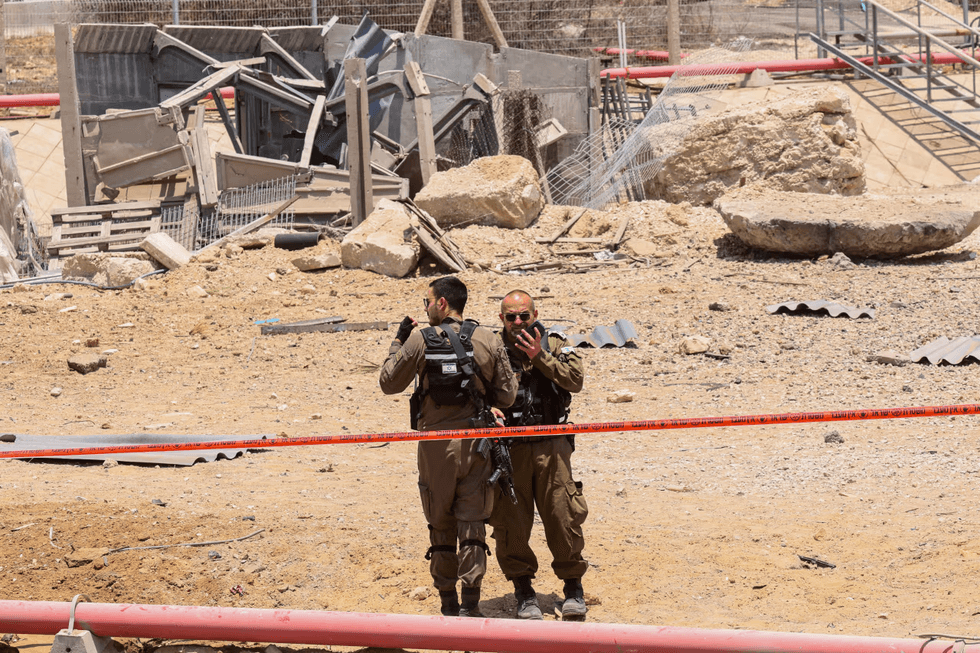
Iran has declared that the private residences of United States and Israeli officials are now legitimate targets in retaliation for airstrikes on residential areas in Iranian cities, as the conflict in West Asia enters its first month and continues to expand across the region.
Ebrahim Zolfaghari, a spokesperson for Iran’s joint military command, said the decision follows attacks on residential areas in Iranian cities. The warning extends to military and political officials residing in Israel and other parts of West Asia.
Earlier on Monday, Israel reported strikes on what it described as military targets in Tehran, following US President Donald Trump’s comments suggesting a possible deal with Iran, while leaving open the option of ground operations.
Iran, in turn, launched fresh missile and drone attacks on targets in Israel, Kuwait, and Saudi Arabia. Electrical facilities in Tehran were damaged over the weekend, cutting power to parts of the capital and surrounding areas.
The ongoing conflict is causing turmoil in global markets. Oil prices have surged, with the US benchmark crude surpassing $100 per barrel and Brent crude approaching $117. Fuel shortages have spread across Asia, while stock markets remain volatile.
The war has intensified hostilities beyond Iran’s borders. Israel continues operations against Iran-backed Hezbollah in southern Lebanon, where Indonesia confirmed the death of one peacekeeper after a projectile struck a UN position. The United Nations Interim Force in Lebanon (UNIFIL) said the origin of the projectile remains under investigation.
US stance and controversial remarks
President Trump claimed that “regime change” had been achieved in Iran, citing the elimination of several Iranian leaders during the month-long conflict. “We’re dealing with a completely different group of people,” he said aboard Air Force One, asserting that the new leadership is “much more reasonable.”
In an interview with the Financial Times, Trump also said he wanted to “take the oil in Iran” and could seize the export hub of Kharg Island, comparing the potential move to US intentions in Venezuela after the capture of President Nicolás Maduro.
Despite the fighting, diplomacy continues. Pakistan hosted foreign ministers from Saudi Arabia, Turkey, and Egypt in Islamabad to discuss ways to “bring an early and permanent end to the war,” according to Pakistani Foreign Minister Bilawal Bhutto Zardari. He said Tehran and Washington had expressed confidence in Pakistan’s role as facilitator and noted discussions with China, the UN, and other international partners.
However, Iran’s parliament speaker Mohammad Bagher Ghalibaf accused the United States of using diplomacy as a cover for military action. “The enemy publicly sends messages of negotiation while secretly planning a ground attack,” he said, warning that Iranian forces are ready to respond to any US deployment.
The United States has bolstered its military presence in the region. The USS Tripoli, an amphibious assault ship carrying approximately 3,500 Marines and sailors, arrived in the Middle East last Friday. According to The Washington Post, the Pentagon has been preparing for weeks of potential ground operations near the Strait of Hormuz, although Trump has not formally approved deployment.
Human cost and infrastructure damage
The conflict has taken a severe toll on civilians in Iran. “I miss a peaceful night’s sleep,” said a Tehran-based artist, describing strikes so intense that “it felt like all of Tehran was shaking.”
Iranian attacks have targeted power stations and water desalination facilities, including a strike in Kuwait that killed an Indian worker and damaged infrastructure. Saudi authorities reported intercepting five ballistic missiles, while Iran acknowledged widespread power outages in Tehran, surrounding regions, and Alborz province.
Iran says it has closed the critical Strait of Hormuz to vessels from “hostile nations.” The waterway previously accounted for roughly a quarter of the world’s seaborne oil trade and a fifth of liquefied natural gas shipments, raising concerns of further disruption to global energy supplies.
Leave a Reply