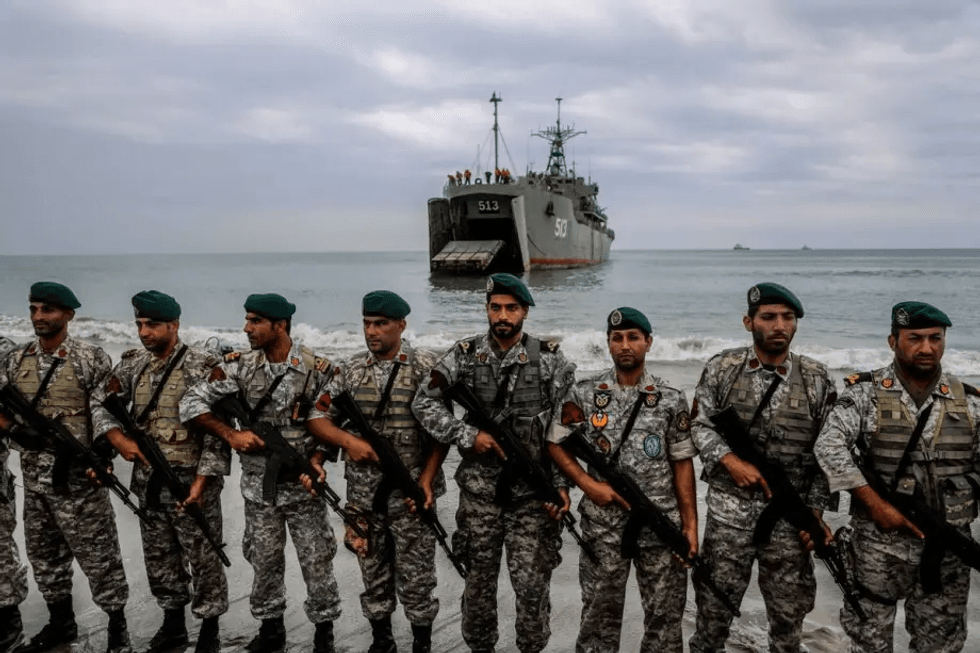
Iran’s military said a US naval blockade set to begin on Monday would be illegal and amount to piracy, warning that no Gulf ports would be safe if its own were threatened.
“The restrictions imposed by criminal America on maritime navigation and transit in international waters are illegal and constitute an example of piracy,” said a statement issued by the Iranian military’s central command center, Khatam Al-Anbiya, that was read on state television.
“If the security of the Islamic Republic of Iran’s ports in the waters of the Persian Gulf and the Arabian Sea is threatened, no port in the Persian Gulf and the Arabian Sea will be safe,” it added.
The warning came after the US military said it would begin a blockade of Iranian ports on Monday following the collapse of talks between the two sides in Pakistan, with President Donald Trump accusing Tehran of refusing to abandon its nuclear ambitions.
Trump announced on social media that the US would move to blockade the strategic Strait of Hormuz, a key global energy corridor, after Vice President JD Vance left negotiations with an Iranian delegation in Islamabad on Sunday.
The breakdown in talks further dimmed prospects for a deal to end a war that has killed thousands and unsettled global markets since it began in late February.
Scope of US military operation
As diplomatic teams departed, Pakistan – acting as mediator – said it would continue facilitating dialogue and urged both sides to respect a fragile two-week ceasefire agreed last week, which analysts warned could be undermined by any escalation at sea.
In a statement, US Central Command said the blockade would be enforced against vessels entering or leaving Iranian ports along the Arabian Gulf and Gulf of Oman, starting at 1400 GMT on Monday, and would apply “impartially against vessels of all nations.”
It added that US forces would not interfere with ships transiting the Strait of Hormuz bound for non-Iranian ports.
Trump later confirmed the military statement on his Truth Social platform, describing it as a more limited operation than his earlier post suggesting a full closure of the strait.
Rising rhetoric and maritime threats
Before the US announcement, Iran’s Revolutionary Guards had warned they maintained full control over traffic in the Strait of Hormuz and threatened to trap any challenger “in a deadly vortex.”
Trump, in his earlier post, said the US goal was to clear the strait of mines and reopen it to global shipping, while preventing Iran from benefiting from control of the waterway.
“Effective immediately, the United States Navy, the Finest in the World, will begin the process of BLOCKADING any and all Ships trying to enter, or leave, the Strait of Hormuz,” Trump wrote, warning that any Iranian attack on US forces or commercial vessels would be met with overwhelming force.
Oil prices surged nearly eight percent on Monday following the escalation, with both Brent and WTI crude briefly crossing the $100-per-barrel mark.
Iranian political response
Iranian officials rejected the US move, with parliament speaker Mohammad Bagher Ghalibaf—who led Tehran’s delegation in Pakistan—saying Iran would “not bow to any threats.”
Iran’s navy chief Shahram Irani also dismissed Trump’s warning as “ridiculous.”
Foreign Minister Abbas Araghchi blamed “maximalism, shifting goalposts, and blockade threats” for the collapse of talks, saying a deal had been “just inches away.”
Trump, however, told reporters he was indifferent to whether negotiations resumed, saying: “I don’t care if they come back or not. If they don’t come back, I’m fine.”
Strategic chokepoint under pressure
Tehran has already been restricting traffic through the Strait of Hormuz, a vital corridor for global oil and gas shipments, while allowing selected vessels from friendly countries such as China to pass.
Experts say any escalation at the strait could have global consequences. Nicole Grajewski of Sciences Po’s Center for International Research said a US blockade would not be a “minor coercive signal” but could instead amount to a de facto continuation of the conflict.
The US military said it had already deployed naval assets in the region to begin clearing maritime mines, a claim Iran has denied. Iranian media also reported that several foreign-flagged oil tankers had turned back from approaching the strait.
Wider regional conflict dynamics
The maritime escalation comes as broader diplomatic efforts to end the war continue to unravel. The conflict, which began after strikes involving Israel and the US, has since expanded into multiple regional theatres.
Lebanon remains a secondary flashpoint, where both Iran and Pakistan-backed mediators insist a ceasefire should apply despite ongoing Israeli operations against Hezbollah positions.
Lebanese Prime Minister Nawaf Salam said efforts were underway to halt the fighting and secure Israeli withdrawal, even as Israeli Prime Minister Benjamin Netanyahu signaled continued military operations in southern Lebanon.
Hezbollah said it had launched rockets toward northern Israel overnight, continuing attacks it said were in response to earlier strikes in the region.
Israeli airstrikes on Beirut and other areas last week killed hundreds, according to Lebanese health authorities, underscoring the risk of broader regional spillover.
Leave a Reply