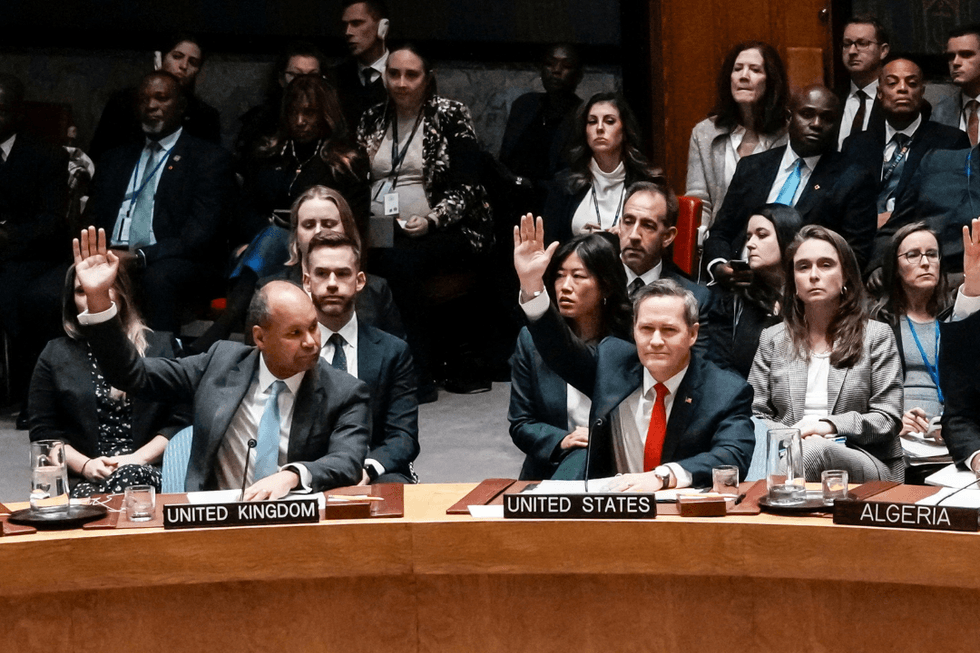
The U.N. Security Council on Monday approved a U.S.-written resolution backing President Donald Trump’s plan to end the Gaza war and authorizing an international stabilization force for the enclave, a move Washington says could open a political door long jammed shut.
Israel and Hamas last month accepted the first phase of Trump’s 20-point proposal, including a ceasefire and a hostage-release arrangement after two years of war. The council’s endorsement is viewed by diplomats as essential for legitimizing a transitional governing body and giving confidence to countries weighing whether to send forces to Gaza.
The resolution says member states may participate in the Trump-chaired Board of Peace, a transitional authority that would guide reconstruction and Gaza’s economic revival. It also authorizes the stabilization force to oversee demilitarization, from decommissioning weapons to dismantling military sites.
Hamas responded by insisting it will not disarm, calling its fight against Israel legitimate resistance. The group said the measure creates a foreign “guardianship” over Gaza that Palestinians reject, signaling likely friction with the authorized force.
U.S. Ambassador Mike Waltz told the council the plan, attached to the resolution as an annex, offers “a possible pathway for Palestinian self-determination,” one where weapons give way to political dialogue. He said it aims to loosen Hamas’ hold and allow Gaza to “rise free from terror’s shadow.”
Russia, which holds veto power and had indicated objections, abstained, enabling passage. Russia and China both argued the measure sidelines the U.N. and hands Washington broad control over Gaza’s future without clarity on how the force will operate.
Russian envoy Vasily Nebenzya said the council had endorsed a U.S. initiative “on the basis of promises,” with few details about the Board of Peace or the stabilization force.
The Palestinian Authority welcomed the resolution and said it is prepared to help implement it. Diplomats said the authority’s support last week was central to discouraging a Russian veto.
Trump hailed the result on social media as “a moment of true historic proportion,” saying appointments to the Board of Peace and other moves will be announced soon.
Pathway to statehood
The measure has stirred controversy in Israel because it suggests conditions may finally exist for a “credible pathway” to Palestinian statehood once the Palestinian Authority completes reforms and reconstruction advances.
The resolution says the United States will open dialogue between Israel and the Palestinians to define a political horizon for coexistence. That language has aggravated tensions within Israel’s governing coalition.
Prime Minister Benjamin Netanyahu, under pressure from right-wing partners, reiterated on Sunday that Israel opposes a Palestinian state and vowed to demilitarize Gaza “the easy way or the hard way,” regardless of the resolution’s framing.
Several council members voiced concern over the lack of a clear U.N. role during Gaza’s transition. China’s envoy said the measure leaves key questions unresolved, including oversight of rebuilding funds and protection for civilians returning to damaged areas.
European diplomats said their governments will wait for detailed guidelines before considering contributions to the stabilization force, noting that past missions faltered when major powers disagreed on command structures.
Regional responses were measured. Egypt said it backs steps that halt violence but stressed Gaza’s governance must remain Palestinian. Jordan said the resolution could aid long-term stability if tied to a real path toward a two-state outcome.
Diplomats warned that implementation will be difficult, with Israeli political divisions and Hamas’ resistance likely shaping the months ahead. Humanitarian agencies also urged guarantees for aid access in Gaza.
Leave a Reply