President Donald Trump said Monday he has not ruled out putting American forces on the ground in Venezuela, while expressing a willingness to hear directly from Nicolás Maduro about the Venezuelan leader’s proposals to avert further U.S. military escalation.
Asked whether he would rule out U.S. troops on the ground in the South American nation, Trump said: “No, I don’t rule out that, I don’t rule out anything.”
Pressed on whether he would speak to Maduro directly, Trump told reporters at the White House: “I probably would talk to him, yeah. I talk to everybody.”
Maduro, responding to Trump’s comments, said disputes should be resolved through diplomacy and insisted he is ready for face-to-face talks with anyone willing to engage.
“In the United States, whoever wants to talk with Venezuela will talk, face to face, without any problem,” Maduro said during his weekly state television broadcast.
The United States has been carrying out deadly strikes on suspected drug-trafficking boats off Venezuela’s coast and along the Pacific waters of Latin America, part of what Washington describes as a campaign to choke the drug trade.
Maduro has repeatedly accused the United States of using military deployments in the Caribbean as a pretext to remove him from power.
Trump’s comments suggest he is willing to escalate the confrontation with Venezuela sharply, even as he leaves open the possibility of dialogue if Maduro offers a proposal compelling enough to ease tensions.
Military pressure and diplomatic signals
Trump also said he would like to eliminate cocaine-making operations in Colombia, while stopping short of announcing any direct intervention there.
While Trump’s public focus has been on curbing drug flows, he is also aware that Venezuela — home to the world’s largest proven oil reserves — is “a very resource-rich country,” a senior White House official told Reuters.
“Just because the president is perhaps interested in hearing what Venezuela has to say does not take off his military options from the table,” the official said, speaking anonymously to discuss diplomatic matters.
The official said Venezuela could offer advantages to U.S. businesses, though the primary concern for now remains drug enforcement.
On Sunday, the Trump administration designated the Cartel de los Soles as a foreign terrorist organization. U.S. officials allege the group includes high-ranking Venezuelan officials, including Maduro himself.
Independent researchers say that although Venezuelan officials have been tied to trafficking, there is little evidence of a top-down, unified criminal structure resembling a cartel.
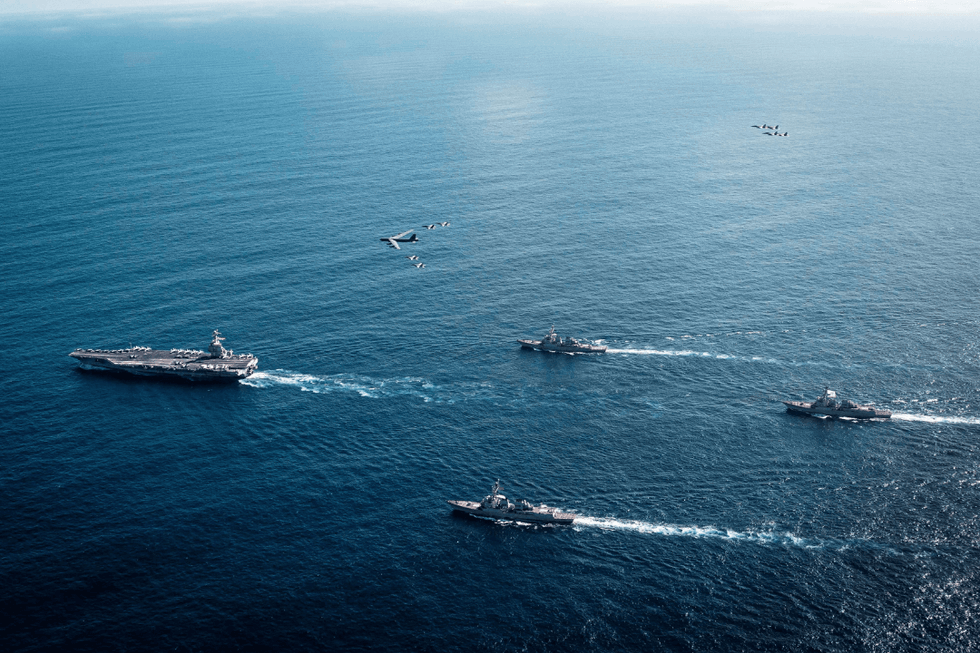
The Pentagon said Sunday — before Trump’s latest remarks — that the Navy’s largest aircraft carrier, the Gerald R. Ford, carrying 5,000 personnel and dozens of warplanes, had moved into the Caribbean. The carrier strike group joins eight warships, a nuclear submarine and F-35 aircraft already deployed to the region.
So far, the Trump administration has focused on bombing boats allegedly used to transport drugs from Venezuela and other Latin American countries.
Human rights groups have condemned the strikes as extrajudicial killings of civilians. The White House argues the United States is at war with drug cartels and that courts are not required in armed conflict.
Leave a Reply