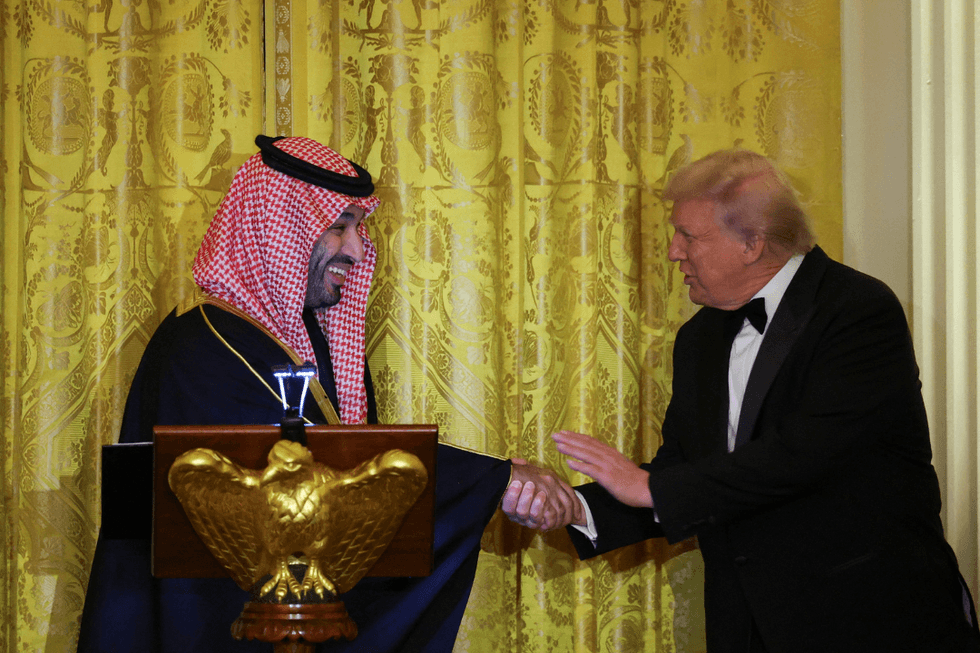
U.S. President Donald Trump said Tuesday that Saudi Crown Prince Mohammed bin Salman knew nothing about the 2018 killing of journalist Jamal Khashoggi by Saudi agents, delivering a forceful public defense of the visiting royal that directly contradicted the findings of U.S. intelligence agencies. The comments reopened a controversy that has shadowed U.S.-Saudi relations for years and resurfaced as the crown prince made his first White House visit in more than seven years.
Khashoggi, a Washington Post columnist and U.S.-based critic of the Saudi leadership, was killed and dismembered inside the Saudi consulate in Istanbul in 2018. The CIA concluded that bin Salman approved the operation to capture or kill him, an assessment Saudi officials have long rejected. The crown prince has denied ordering the killing, though he acknowledged responsibility as the country’s de facto leader.
The Oval Office exchange unfolded before television cameras as bin Salman sought to further rehabilitate his global image, which remains marred by the killing and by an international campaign by human rights groups that has branded him responsible for the kingdom’s harsh crackdown on dissent.
Trump later announced that he was designating Saudi Arabia as a major non-NATO ally, a status that grants military and economic privileges without obligating U.S. security commitments. The two governments also unveiled agreements on arms sales, civil nuclear cooperation, artificial intelligence and critical minerals.
Trump contradicts intelligence findings
Despite the U.S. intelligence assessment, Trump insisted that bin Salman played no role in Khashoggi’s death.
“A lot of people didn’t like that gentleman that you’re talking about, whether you like him or didn’t like him,” Trump told reporters, with bin Salman sitting beside him. “Things happened, but he knew nothing about it, and we can leave it at that.”
Bin Salman, asked about the killing, said it remained “painful” and that his government had taken “all the right steps of investigation.”
“We’ve improved our system to be sure that nothing happened like that,” he said. “And it’s painful and it’s a huge mistake.”
Trump scolded the reporter who raised the Khashoggi case, accusing the journalist of trying “to embarrass our guest.” He praised the crown prince for doing an “incredible” job on human rights but did not explain what he meant.
The remarks drew a quick rebuke from Khashoggi’s widow, Hanan Elatr Khashoggi, who spoke to Reuters after the Oval Office session.
“Nothing can justify just a horrible crime… because he’s controversial or he’s unliked by someone,” she said. She added that she wished Trump would meet with her to learn about the “real Jamal.”
Human rights criticism and social reforms
Bin Salman has long faced criticism from human rights organizations not only for Khashoggi’s killing but also for mass arrests of activists, clerics and dissidents. Yet he has also enacted sweeping social changes under his Vision 2030 plan, rolling back austere restrictions on women and public life and promoting a more open cultural environment.
Trump, who has embraced the crown prince as a key strategic partner, has made strengthening the U.S.-Saudi relationship a priority in his second term, even as Khashoggi’s death remains a point of friction in Washington.
Arms sales and nuclear agreement
The White House event marked a renewed high point in U.S.-Saudi ties. Trump’s predecessor, Joe Biden, traveled to the kingdom and met the crown prince but declined to host him at the White House amid tensions over the killing.
Trump said he received a “positive response” regarding Saudi Arabia’s potential normalization of ties with Israel. But bin Salman reiterated his longstanding position that Israel must offer a credible path to Palestinian statehood before Riyadh can join the Abraham Accords.
At a formal black-tie dinner later in the evening, Trump said he was “taking our military cooperation to even greater heights” by designating Saudi Arabia a major non-NATO ally. He also said U.S. strikes on Iranian nuclear facilities in June had made Saudi Arabia safer.
A White House fact sheet said the United States and Saudi Arabia had signed a Strategic Defense Agreement aimed at strengthening deterrence across the Middle East, smoothing the path for American defense companies to operate in the kingdom, and securing new Saudi burden-sharing funds to offset U.S. costs. The agreement fell short of the NATO-style treaty the Saudis initially pursued.
The White House also announced that Trump approved future deliveries of F-35 fighter jets and that Saudi Arabia agreed to buy 300 American tanks. Riyadh has requested 48 F-35s, and any sale would mark a major policy shift by making Saudi Arabia the first Arab country to acquire the stealth aircraft. Israel has been the only Middle Eastern nation permitted to operate the F-35, under U.S. policy guaranteeing Israel’s “qualitative military edge.”
The two countries also signed a declaration concluding negotiations on a civil nuclear energy cooperation framework. The agreement creates a legal structure for long-term collaboration, though the Saudis and Americans have clashed for years over U.S. demands that Riyadh forgo enriching uranium or reprocessing spent fuel—steps that could bring the kingdom closer to a potential nuclear weapon.
Crown prince boosts investment pledge
Bin Salman arrived in Washington to a display of pomp and ceremony, including a military honor guard, a cannon salute and a U.S. warplane flyover on the South Lawn. Sitting beside Trump, he promised to increase Saudi investment in the United States to $1 trillion, up from a $600 billion pledge he made during Trump’s visit to the kingdom in May. He offered no timeline or details.
The White House said the two sides had also signed a memorandum of understanding on artificial intelligence and a framework for cooperation on critical minerals.
Analysts say a $1 trillion investment would be challenging for Saudi Arabia, which is already spending heavily on ambitious domestic megaprojects such as NEOM, many of which have exceeded planned budgets.
Bin Salman is expected to promote his Vision 2030 economic diversification agenda at an investment conference in Washington on Wednesday, attended by major international executives at the John F. Kennedy Center for the Performing Arts.
In the Oval Office, Trump denied any conflict of interest involving his family’s extensive business dealings with Saudi investors.
“I have nothing to do with the family business,” Trump said. “I have left, and I’ve devoted 100% of my energy. What my family does is fine. They do business all over.”
The White House has repeatedly said Trump ended his business involvement after taking office by placing his assets into a trust managed by his children. As the trust’s beneficiary, however, Trump will have access to revenue generated during his presidency once he leaves office.
Leave a Reply