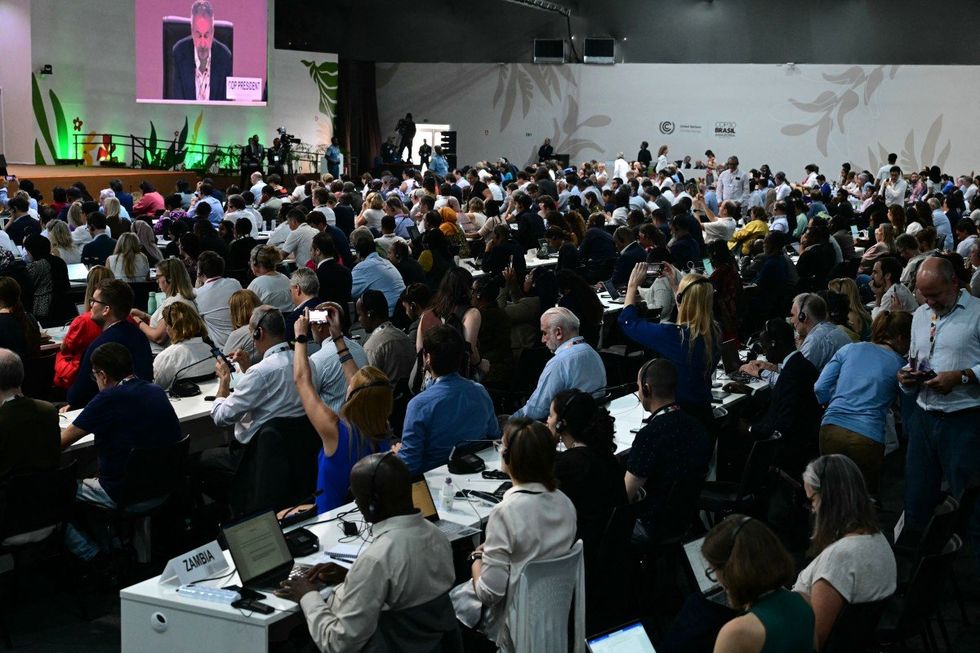
The clock ticked down on Friday on the scheduled final day of UN climate negotiations in Brazil, where a fierce battle over whether to include any mention of fossil fuels in the outcome document threatened to throw COP30 into disarray.
At stake is a deal that could chart faster cuts to planet-warming emissions driving increasingly destructive weather events, while signaling that global cooperation on climate remains possible despite deep geopolitical fractures.
After nearly two weeks of bargaining in the Amazonian city of Belem, a new draft text released by Brazil omitted any reference to “fossil fuels” and abandoned the word “roadmap,” language President Luiz Inácio Lula da Silva had publicly endorsed.
European Union climate commissioner Wopke Hoekstra called the draft “unacceptable,” warning that the summit was now on track to conclude without consensus.
“I am saying it with a heavy heart, but what is on the table is clearly no deal,” Hoekstra told reporters.
Mounting tensions
A European delegate, speaking on condition of anonymity, said the bloc was being cast as “villains” for refusing to accept the proposal. Some member states were considering a walkout, the delegate said, while others feared being blamed if the negotiations collapsed.
The conference, already disrupted for hours Thursday by a fire that tore open part of the venue’s roof, had also faced two Indigenous-led protests earlier in the week. Officials had expected talks to end Friday at 6 p.m. local time, but well past that hour delegations were returning to hotels as it became clear the summit would spill into the weekend.
Consensus required
Thirty-six countries, a group spanning industrialized nations, emerging economies, and small island states, warned Brazil in a letter that they would reject any deal lacking a credible plan to move away from oil, coa,l and gas.
France’s ecological transition minister, Monique Barbut, told AFP that Russia and Saudi Arabia — both major oil producers — joined coal-reliant India and “many” emerging economies in resisting the language.
Arunabha Ghosh, a special envoy for South Asia, pushed back against what he called harmful “finger-pointing.”
“To assume that one side cares about the planet and the other side, because they are unhappy with the formulation, does not care about the planet, does grievous harm to the spirit of negotiations,” he told AFP.
Ghosh defended leaving out the “roadmap,” saying developing nations must prioritize energy security and ensure a just transition for workers dependent on fossil fuel industries.
Reaching an agreement requires unanimity among nearly 200 nations. This year’s talks have unfolded without the participation of the United States after President Donald Trump declined to send a delegation.
COP30 president André Corrêa do Lago said the deadlock would delight those who argue global cooperation on climate is futile. “They are going to be absolutely delighted to see that we cannot reach an agreement between us,” he said.
Money dispute
The push to phase out oil, coal and gas — the biggest drivers of global warming — grew out of frustration with slow follow-through on the COP28 agreement in Dubai, which pledged to transition away from fossil fuels.
But disagreements persist over trade provisions and financing for poorer nations struggling to adapt to worsening climate impacts such as droughts and floods, and to shift toward low-carbon development.
The rejected draft called for a “manyfold increase” in financial support to developing countries and for “efforts to triple adaptation finance” by 2030 compared with 2025 levels.
“The EU is stuck with a much earlier tripling of adaptation finance than they’re comfortable with, and in exchange, they got nothing,” said Jake Schmidt, senior strategic director at the Natural Resources Defense Council. “It’s a tough pill to swallow,” he told AFP.
For the first time, trade appeared as a dedicated pillar in the proposal, echoing concerns from developing economies that taxes on carbon-intensive imports — including Europe’s new Carbon Border Adjustment Mechanism — could diminish their export revenues.
It was another component the EU had not wanted included.
Leave a Reply