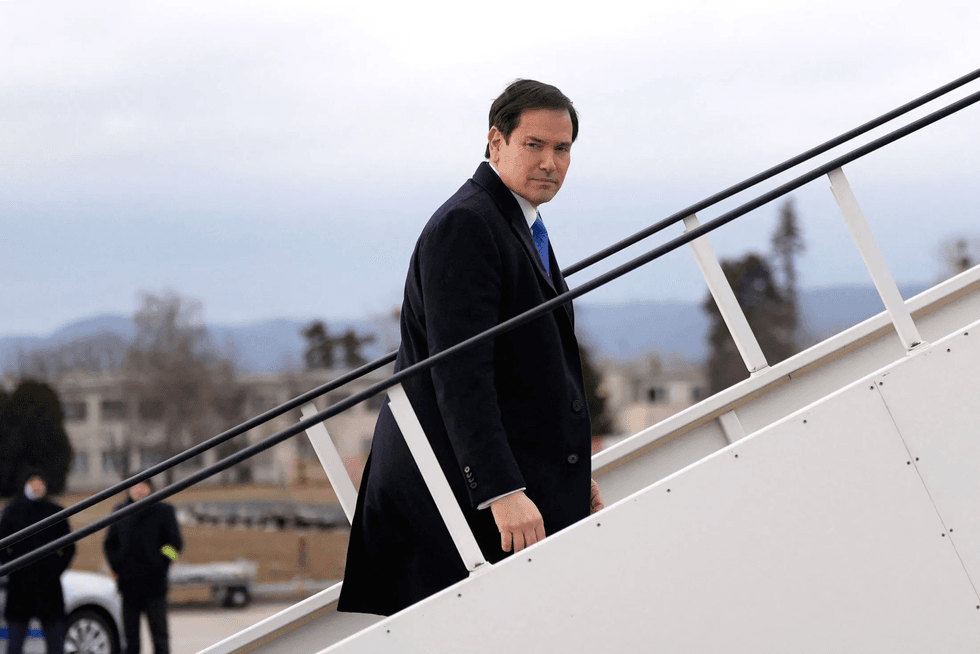
US Secretary of State Marco Rubio travels to India this weekend on a multi-city tour, his most extensive trip yet as America’s top diplomat.
The visit comes as India grapples with a pointed question: how does it fit into the norms-breaking, highly personalized foreign policy worldview of President Donald Trump? The backdrop includes punitive tariffs on Indian goods, a warmer US tone toward China, and a revived US partnership with Pakistan.
Where does India stand in Trump’s foreign policy worldview?
Since the late 1990s, US presidents across party lines prioritized wooing India, overlooking disagreements in the belief that the world’s largest democracy would serve as a natural counterweight to a rising China.
Trump has shifted that playbook. He hailed his recent state visit to China despite limited outcomes, while his deputy secretary of state warned against repeating with India the “same mistakes” made commercially with China.
Why is Pakistan re-emerging as a factor in US-India relations?
Pakistan, India’s historic adversary, has re-entered the strategic equation after decades on the margins. Pakistani leaders have ceaselessly flattered Trump and credited his diplomacy with ending a brief war with India last year.
Returning to their Cold War role as a US partner, Pakistani officials have also led mediation in the Iran war, a contribution that earned a visit last month from Vice President JD Vance.
When the Trump administration released its national security strategy, India barely featured. The document focused on asserting US primacy in Latin America and contesting Europeans on cultural issues, leaving India’s strategic place undefined.
How has the US-India relationship changed under Trump?
Trade and military purchases between the two countries have continued to grow, said Aparna Pande, a senior fellow at the Hudson Institute. “But the strategic dimension is lacking,” she said. “All the points of friction from the Cold War are back again.”
She added that the strategic framework which had previously kept those stress points from damaging the relationship was “no longer there.”
What will Rubio do during his India visit?
Rubio will visit four cities starting Saturday, beginning a tour that is unusually extensive by his standards as a diplomat known for swift, business-like travel. He will attend a gala reception in New Delhi marking the 250th anniversary of US independence, visit Kolkata, home to one of the oldest US consulates, and tour the Taj Mahal in Agra and palace-filled Jaipur.
In New Delhi, he will also meet counterparts from the Quad, the grouping of Australia, India, Japan and the US that China has long viewed as a strategy to encircle it.
Who is driving Rubio’s extensive India trip?
Rubio’s four-city itinerary was largely shaped by US Ambassador to India Sergio Gor, who carries unusual influence within the administration. Gor previously oversaw the staffing of the second Trump administration with loyalists, giving him direct access to the president.
The 39-year-old engineered a trade deal shortly after arriving in New Delhi in January that eased Trump’s tariffs on India, and has accompanied Rubio on trips with no direct India connection, including a visit to Rome to meet Pope Leo XIV earlier this month.
How has the Modi-Trump relationship shaped US-India ties?
Trump initially formed a close bond with Indian Prime Minister Narendra Modi, who invited him to address a massive rally at a cricket stadium during his first term.
Both leaders are right-wing populists who rose to power by championing the grievances of their countries’ majority communities. But Modi irritated Trump by downplaying his role in mediating the brief India-Pakistan war last year, launched after a massacre of mostly Hindu civilians in Indian-administered Kashmir. Pakistan, by contrast, publicly said Trump deserved the Nobel Peace Prize.
What does India want from Rubio’s visit?
India has been careful not to engage in a tit-for-tat with Trump, including over tariffs, believing its long-term interests are best served by maintaining strong US ties, said Tanvi Madan, a senior fellow at the Brookings Institution.
“The India-US relationship had benefited from competition with China being almost an organizing principle” for US foreign policy under both Trump’s first term and Joe Biden, she said.
On Rubio’s visit, Madan said India would want clarity on “how much that strategic convergence that had persisted for several years is going to continue to drive this relationship.”
Leave a Reply