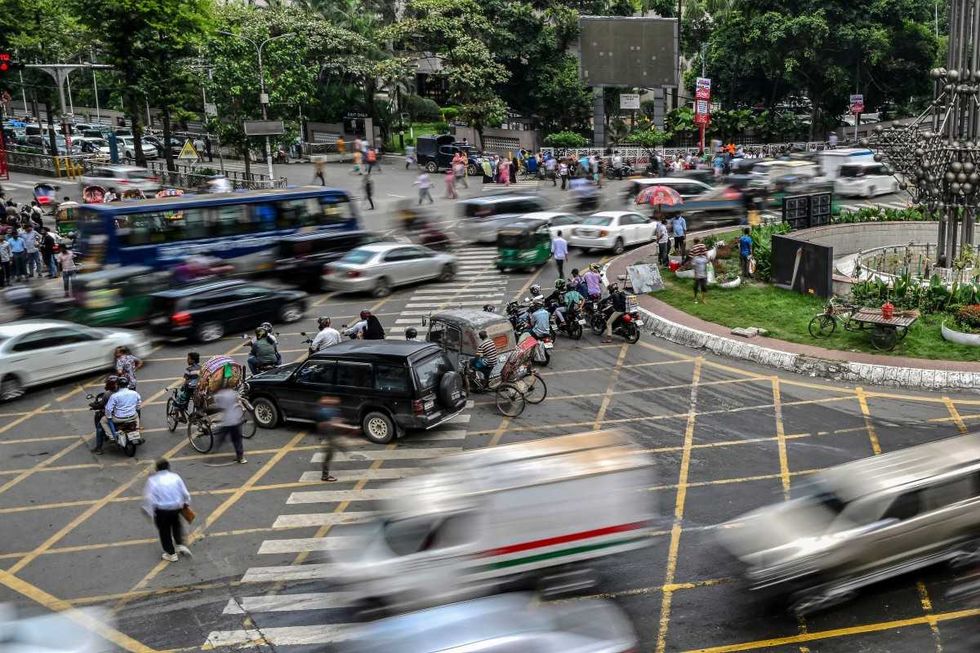
Bangladesh’s capital has launched its first AI-powered traffic enforcement system in a bid to bring order to one of the world’s most congested cities.
Dhaka, home to more than 22 million people and infamous for gridlock, activated the system in April, linking existing traffic cameras to software that automatically detects violations and issues fines.
How does Dhaka’s AI traffic enforcement system work?
The system connects existing traffic-monitoring camera feeds to AI software that identifies offences including signal violations, illegal lane changes and unauthorized parking.
When a violation is detected, it is flagged for human review before a fine is issued. Registered vehicle owners receive an automatic text message, with penalties starting at 2,000 taka ($16).
What problems was Dhaka’s traffic system facing before AI?
Despite repeated modernization attempts, Dhaka had remained dependent on manual traffic control. Officers stretched ropes across roads before lights turned green, on-the-spot fines sparked frequent arguments, and confrontations were common.
One study by the US National Bureau of Economic Research ranked Dhaka the slowest city in the world, while a separate World Bank and Bangladesh University of Engineering and Technology study found its average traffic speed was just 4.8 kilometers per hour, slower than walking.
Traffic sergeant SM Nazim Uddin described the daily friction officers faced. “Those who violate the rules turn against us,” he told AFP. “But since AI was introduced, people behind the wheel have started obeying the law, and we have been spared the everyday quarrels.”
Is Dhaka’s AI camera system actually changing driver behavior?
Early signs suggest it is. Motorist Hannan Rahman Jibon, 28, was among the first drivers caught after running a red light. His car’s owner received an automatic text message at home before Jibon even arrived back.
“I am more careful now, with cameras installed in many different parts,” he said. Police say they have prosecuted at least 300 vehicles since launch, though for now officers are only fining the worst offenders while issuing warnings to others.
Inside the control room at police headquarters, analyst Sharmin Afroze, 52, monitors live camera feeds flagged by the AI. She said the system recorded nearly 800 traffic violations in a single day.
“Before, police used to stop vehicles, check papers and determine fines,” Afroze told AFP. City police spokesman N.M. Nasiruddin said coverage does not yet span the entire city, and manual enforcement will be phased out gradually. “We have started getting results,” he said.
What challenges does the AI traffic system still face?
Officials acknowledge the technology has limits. Some number plates are blurred or too small for the system to read, and police are working with the road transport authority to resolve the problem.
Additional detection features, including vehicles driving on footpaths, are planned. The system currently targets motor vehicles only, leaving Dhaka’s vast fleet of pedal rickshaws outside its scope.
Hasib Mohammed Ahsan, a professor at Bangladesh University of Engineering and Technology, cautioned that the system’s long-term success depends less on technology than on consistent enforcement.
“We have spent huge amounts of money on traffic signals and their upgrades, but those efforts were never sustained,” he said. “We do not follow rules, there is no consistency in our planning, and there is no accountability for failure.”
Leave a Reply