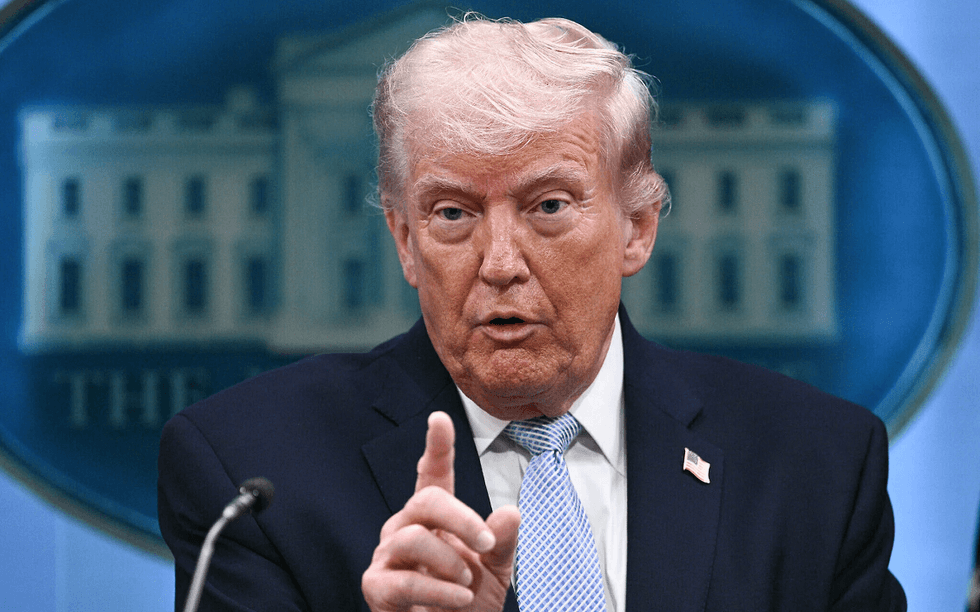
U.S. President Donald Trump said Tuesday that American forces intercepted a ship carrying what he described as a “gift” from China to Iran, as tensions rise over a fragile ceasefire and uncertain peace talks.
The vessel had “a gift from China” which “wasn’t very nice,” Trump told CNBC. “I was a little surprised,” he added, saying he believed he had an “understanding” with Chinese President Xi Jinping.
A week earlier, Trump said Xi had assured him there would be no Chinese weapons deliveries to Iran, a long-time partner of Beijing.
Trump also said he did not want to extend the ceasefire with Iran, arguing the United States held a strong negotiating position and would secure what he called a “great deal.”
“I don’t want to do that. We don’t have that much time,” he said when asked about extending the truce.
He warned the U.S. would resume attacks if an agreement was not reached soon.
“I expect to be bombing because I think that’s a better attitude to go in with. But we’re ready to go. I mean, the military is raring to go,” he said.
The prospect of last-ditch talks in Islamabad remains uncertain, with no confirmation that Iran will send a delegation. Washington has expressed confidence the negotiations will proceed in Pakistan, while an Iranian official said Tehran was still considering participation.
Trump earlier accused Iran of violating the ceasefire “numerous times” in a post on Truth Social.
In a separate interview with The John Fredericks Show, he said Iran would eventually return to negotiations and warned of severe consequences if it did not.
“Well, they’re going to negotiate, and if they don’t, they’re going to see problems like they’ve never seen before,” he said.
Trump said he hoped for a “fair deal” that would allow Iran to rebuild while permanently preventing it from obtaining nuclear weapons.
“They’ll have no access to, no chance of having, a nuclear weapon. And we can’t allow that to happen,” he said.
He also defended recent U.S. military action.
“And I have to say, we had no choice in Iran. It wasn’t like we had a choice. We had to do it,” he said.
His remarks came as Washington and Tehran exchanged warnings over the ceasefire, with uncertainty surrounding U.S.-announced talks in Pakistan. The White House said Vice President JD Vance was prepared to travel to Pakistan for a second round of negotiations.
Iranian officials have not confirmed participation and accused Washington of undermining the truce through continued pressure, including maritime restrictions.
Mohammad Bagher Ghalibaf, who led Iran’s delegation in earlier Islamabad talks, said the United States was trying to force concessions.
“By imposing a blockade and violating the ceasefire, Trump wants to turn this negotiating table into a surrender table or justify renewed hostilities, as he sees fit,” Ghalibaf said on X.
“We do not accept negotiations under the shadow of threats, and in the last two weeks we have been preparing to show new cards on the battlefield,” he added.
Iran’s Revolutionary Guards separately warned they would target vessels attempting to pass through the Strait of Hormuz without authorization, increasing pressure on one of the world’s most critical oil routes.
Trump, in other interviews, said Iran was expected to attend the Pakistan talks and warned of escalation if diplomacy failed.
“We agreed to be there,” he told PBS News, adding that if the ceasefire expired, “then lots of bombs start going off.”
He told Bloomberg News it was “highly unlikely” the truce would be extended.
While the ceasefire was due to expire overnight Tuesday in Tehran, Trump said it could continue until Wednesday evening in Washington, creating confusion over the timeline.
Financial markets reacted cautiously, with oil prices easing and equities rising on hopes diplomacy could prevent renewed conflict and reopen the Strait of Hormuz.
In Tehran, residents expressed uncertainty despite a relative return to normal life during the truce.
“Let’s see what happens by Tuesday,” a 30-year-old doctor told AFP on condition of anonymity.
Another resident, Saghar, 39, said economic conditions remained difficult. “The economy is horrible,” she said.
Separately, a ceasefire between Israel and Lebanon announced Friday remained fragile amid continued Israeli warnings over alleged violations in southern Lebanon.
Israel and Lebanon are expected to hold a second round of indirect talks in Washington on Thursday, according to a U.S. State Department official.
Leave a Reply