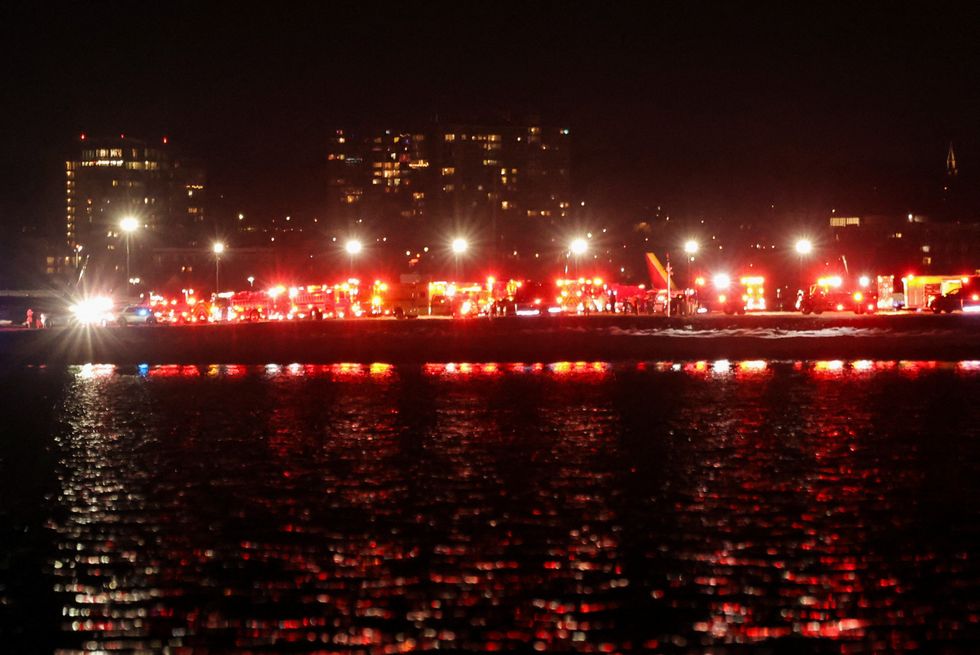
The U.S. Army Black Hawk helicopter that collided with a passenger jet over Washington on Wednesday was on a routine training flight for a classified military mission designed to evacuate senior government officials in the event of a national crisis, defense officials confirmed.
The mission, known as “continuity of government” and “continuity of operations,” ensures that key U.S. government functions remain intact in times of war or catastrophe. While largely undisclosed to the public, these operations involve relocating senior officials to secure locations.
Defense Secretary Pete Hegseth acknowledged the Black Hawk crew’s role during a White House press conference Thursday, stating, “They were on a routine, annual re-training of night flights on a standard corridor for a continuity of government mission.”
The collision killed three soldiers from the 12th Aviation Battalion, based at Fort Belvoir, Virginia, a unit tasked with transporting VIPs around Washington and evacuating Pentagon officials in emergencies. The crash also claimed the lives of 64 passengers aboard the jet.
The Black Hawk was flying a night training mission along Route 4 over the Potomac River using night vision goggles when the accident occurred. Military officials have defended nighttime operations in the area, citing the battalion’s critical role in national security.
Historic role in national crises
The most recent known activation of a continuity of operations mission took place on Sept. 11, 2001, when al Qaeda hijackers targeted the World Trade Center and the Pentagon, killing nearly 3,000 people.
On that day, the 12th Aviation Battalion helped evacuate senior leaders to secretive “hide sites,” according to Bradley Bowman, a former Army aviation officer who participated in those emergency flights. Later that evening, Bowman piloted a Black Hawk to retrieve then-Deputy Secretary of Defense Paul Wolfowitz from a classified bunker and transport him back to the Pentagon.
“There was just one problem—the Pentagon’s helicopter pad had been destroyed,” Bowman recalled. “We repositioned and landed in the traffic circle of I-395, which had been closed by that point.”
Wolfowitz later described his shelter as a “bizarre location prepared to survive nuclear war.”
The site was Raven Rock Mountain Complex, also known as “Site R,” a highly secure underground facility near Camp David. According to journalist Garrett Graff, the author of a 2017 book on government continuity plans, Raven Rock remains one of three primary U.S. government backup locations and the primary continuity site for Pentagon leadership.
“It’s 100 percent operational today,” Graff said. “There’s a team of maybe 100 personnel inside Raven Rock right now, ready to pick up the pieces of the U.S. government if necessary.”
As investigations into Wednesday’s collision continue, scrutiny has mounted over military flight operations near Washington’s heavily trafficked airspace. However, Pentagon officials maintain that such training is vital to national security.
The U.S. Army has launched an internal review to assess the circumstances surrounding the crash.
Leave a Reply