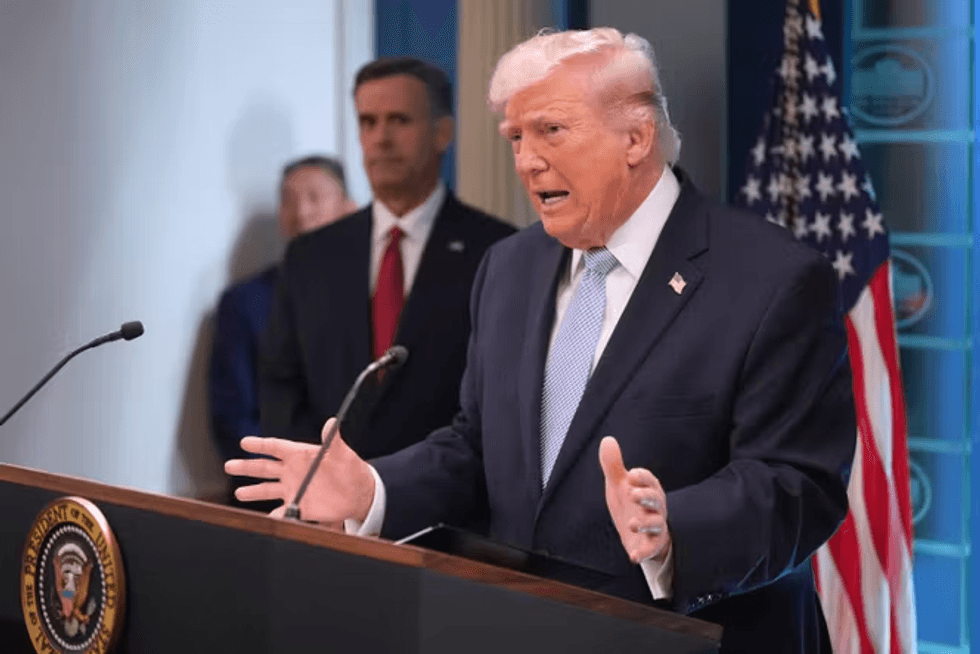
US President Donald Trump on Tuesday said Iran is “collapsing financially” amid tensions over the Strait of Hormuz, as he escalated pressure on Tehran while maintaining a fragile ceasefire.
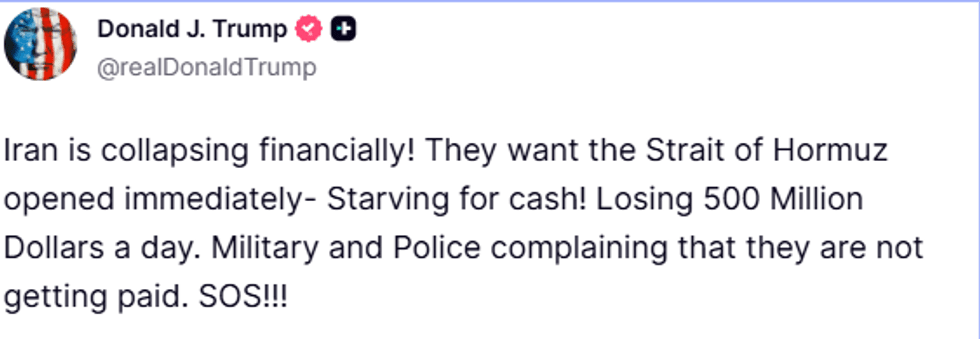
“Iran is collapsing financially! They want the Strait of Hormuz opened immediately,” Trump wrote on Truth Social, adding that the Islamic Republic was “starving for cash.”
Earlier, Trump said Iran’s calls for restricting the vital shipping lane were aimed at “saving face” under what he described as a U.S. blockade of Iranian ports.
Reinforcing that position on Wednesday, he again said Tehran was signaling a desire to reopen the Strait despite its public rhetoric. “They only say they want it closed because I have it totally blockaded,” he said, adding that intermediaries had recently conveyed Iran’s interest in reopening the waterway.
His remarks came alongside a decision to indefinitely extend a two-week ceasefire with Iran, which had been nearing expiry. Trump said the extension followed a request from mediator Pakistan and was intended to give Iran’s leadership more time to present a proposal, while U.S. forces maintained pressure through a continued blockade of Iranian ports.
Trump had previously warned the truce could end without extension and raised the prospect of renewed military action if talks collapsed. “I have directed our military to continue the blockade… and will therefore extend the ceasefire until such time as their proposal is submitted,” he said.
The original deadline passed without reports of renewed hostilities. Iran, which had indicated a slightly different timing for the ceasefire’s expiry, did not immediately respond to the extension.
Diplomatic uncertainty
The status of Pakistan-hosted talks remained unclear, with a White House official saying Vice President JD Vance would not travel to Islamabad as scheduled, pending an Iranian proposal.
“Any further updates on in-person meetings will be announced,” the official said.
Security was tightened in Islamabad’s government district despite no confirmed schedule for negotiations. Prime Minister Shehbaz Sharif and U.N. Secretary-General Antonio Guterres both welcomed the extension of the ceasefire.
Tensions had remained elevated ahead of the deadline, with Iran warning Gulf states against allowing their territory to be used for any attacks. Revolutionary Guards aerospace commander Majid Mousavi warned that countries enabling such actions could face severe consequences for their oil infrastructure.
Military pressure and maritime tensions
Since the start of talks, Washington has imposed a blockade on Iranian ports, while Tehran has moved to close the Strait of Hormuz, a key global oil route.
The U.S. Defense Department said its forces intercepted and boarded a “stateless sanctioned” vessel linked to networks supporting Iran, as part of ongoing enforcement operations.
Both sides have accused each other of violating the ceasefire.
‘Cursed ceasefire’
Despite the truce, living conditions in Iran remain strained.
“This cursed ceasefire has broken us. There is no light at the end of the tunnel,” said Saghar, 39, in Tehran.
Analysts say Iran’s public ambiguity may be a negotiating tactic. “The standoff… is now a struggle of political endurance and bargaining leverage,” wrote Daniel Byman of the Center for Strategic and International Studies.
Global markets, however, showed cautious optimism, with stocks rising on hopes of a diplomatic breakthrough.
Islamabad lockdown
Elsewhere, tensions continued to simmer on another front of the broader regional conflict. Israel and Lebanon are set to hold talks in Washington on Thursday following a separate 10-day ceasefire involving Hezbollah.
Despite the truce, violence has persisted, with Israel reporting rocket fire from Hezbollah and carrying out retaliatory strikes. Israeli authorities have warned civilians against returning to parts of southern Lebanon.
Lebanese officials say Israeli strikes have killed more than 2,400 people since the conflict began, while Hezbollah said it carried out attacks in response to alleged ceasefire violations.
Leave a Reply