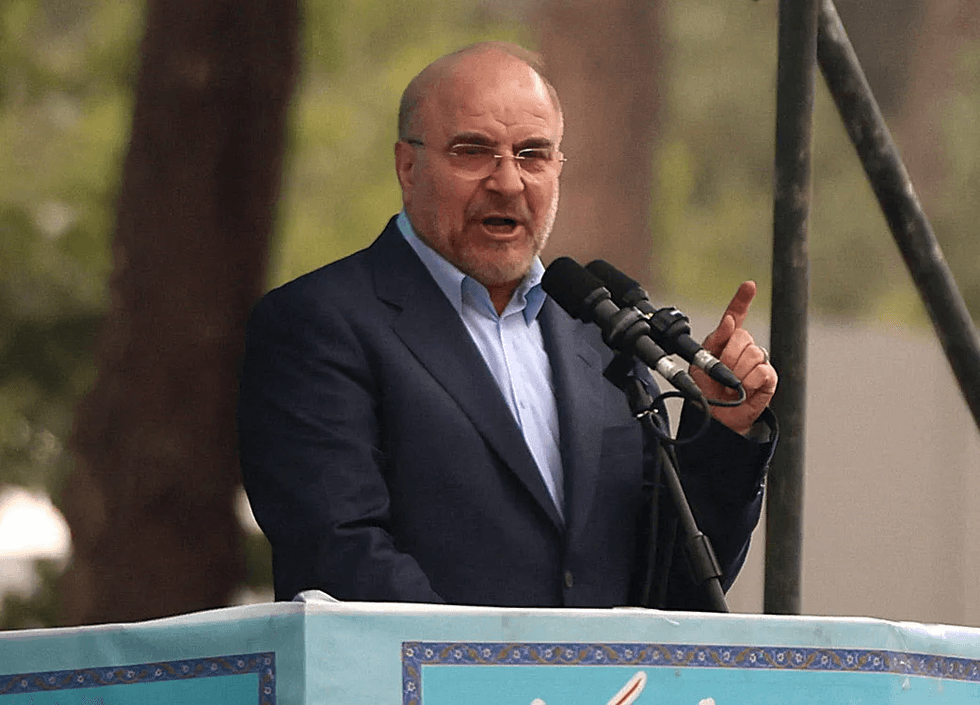
Iran’s parliament speaker Mohammad Bagher Ghalibaf declared Monday that the United States has no viable option but to accept Tehran’s 14-point proposal, warning that delays would prove costly for American taxpayers.
His remarks came after President Donald Trump rejected Iran’s counterproposal and said the month-long Middle East ceasefire was on “massive life support.” Oil prices rose sharply on the exchange.
What is Iran’s 14-point proposal and why is the US rejecting it?
Iran’s 14-point proposal calls for an end to the US naval blockade of Iranian ports, a broader halt to hostilities across the region, and the release of Iranian assets frozen in foreign banks.
Trump called the position “TOTALLY UNACCEPTABLE,” saying the US was pursuing “complete victory.” The Wall Street Journal reported the proposal also included an offer to dilute some highly enriched uranium, with remaining stockpiles transferred to a third country.
What did Ghalibaf say about the Iran-US negotiations?
Ghalibaf, a former senior IRGC commander and chief negotiator in earlier talks with Washington, posted his remarks on X in English. “There is no alternative but to accept the rights of the Iranian people as laid out in the 14-point proposal,” he wrote.
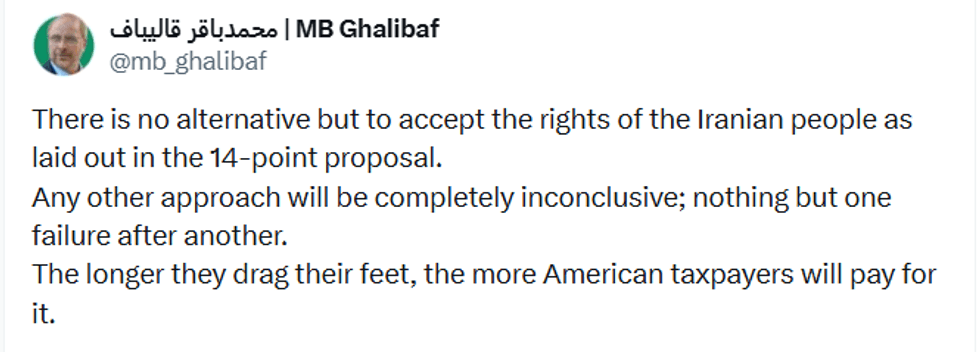
“Any other approach will be completely inconclusive; nothing but one failure after another. The longer they delay, the more American taxpayers will pay for it.”
His remarks reflect Tehran’s broader strategy of projecting resolve while framing the cost of deadlock in economic terms for Washington. Shortly after Trump’s comments, Ghalibaf also warned that Iran’s armed forces were ready to “teach a lesson for any aggression.” The exchange further darkened the outlook for a near-term diplomatic resolution.
How close is the Middle East ceasefire to collapsing?
Trump described the ceasefire, in place for just over a month since April 7, as being on its last legs. “The ceasefire is on massive life support, where the doctor walks in and says, your loved one has approximately a one percent chance of living,” he told reporters. The breakdown of talks also pushed oil prices higher and reduced expectations of a quick deal to reopen the Strait of Hormuz.
US officials have said it would be “unacceptable” for Tehran to control the strait, a critical chokepoint for global energy shipments. Iran has moved to regulate maritime traffic there and introduce a toll mechanism for passing vessels.
Trump told Fox News he was considering reviving a short-lived US escort operation for commercial tankers, though no final decision had been made. Regional sources told AFP that Saudi Arabia had previously declined to allow the use of its airspace or bases for such an operation, citing fears of escalation.
What are the energy and humanitarian consequences of the conflict?
Saudi Aramco CEO Amin Nasser told investors the disruption represented the largest energy supply shock on record, warning that markets could take months to stabilize even if the strait reopened immediately.
He added that if the opening were delayed by several more weeks, normalization could stretch into 2027. Global energy markets have already been thrown into volatility by the conflict and the overlapping restrictions around the strait.
The humanitarian picture has also worsened. The United Nations Office for Project Services warned of a widening global fertilizer shortage, much of it routed through Gulf ports, with direct consequences for food security worldwide.
UNOPS Executive Director Jorge Moreira da Silva said only a narrow window remained to prevent a “massive humanitarian crisis,” warning that the situation could force 45 million more people into hunger and starvation.
What does Iran want from a nuclear deal and what does the US demand?
Tehran’s foreign ministry confirmed its proposal demanded the release of Iranian assets it said had been frozen in foreign banks for years, a long-standing demand in nuclear negotiations. Any such concession would reduce Washington’s leverage over Iran’s nuclear program and broader sanctions regime. The United States, Israel and several allies accuse Iran of pursuing nuclear weapons, a claim Tehran denies.
Israeli Prime Minister Benjamin Netanyahu has repeatedly insisted the conflict will not end until Iran’s nuclear facilities are dismantled. The Wall Street Journal also reported, citing unnamed sources, that the United Arab Emirates carried out strikes on a refinery on Iran’s Lavan Island in early April, marking previously undisclosed Emirati involvement in the conflict.
AFP has not independently confirmed that claim. Washington separately announced new sanctions on 12 individuals and entities in Iran, Hong Kong and the UAE accused of facilitating Iranian oil exports to China.
Leave a Reply